







Mostrar el registro sencillo del ítem
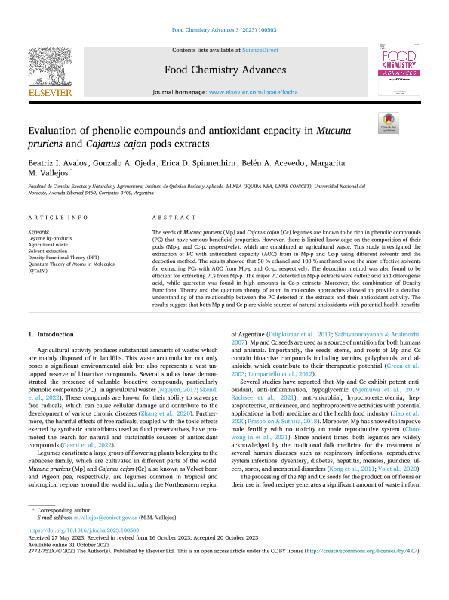
Evaluation of phenolic compounds and antioxidant capacity in Mucuna pruriens and Cajanus cajan pods extracts
| dc.contributor.author | Avalos, Beatriz Itatí | |
| dc.contributor.author | Ojeda, Gonzalo Adrián | |
| dc.contributor.author | Spinnenhirn, Erica Danisa | |
| dc.contributor.author | Acevedo, Belén Andrea | |
| dc.contributor.author | Vallejos, Margarita de las Mercedes | |
| dc.date.accessioned | 2025-12-05T11:11:41Z | |
| dc.date.available | 2025-12-05T11:11:41Z | |
| dc.date.issued | 2023-12-01 | |
| dc.identifier.citation | Avalos, Beatriz Itatí, et al., 2023. Evaluation of phenolic compounds and antioxidant capacity in Mucuna pruriens and Cajanus cajan pods extracts. Food Chemistry Advances. Ámsterdam: Países Bajos, vol. 3, p. 1-8. E-ISSN 2772-753X. DOI https://doi.org/10.1016/j.focha.2023.100503 | es |
| dc.identifier.uri | http://repositorio.unne.edu.ar/handle/123456789/59146 | |
| dc.description.abstract | The seeds of Mucuna pruriens (Mp) and Cajanus cajan (Cc) legumes are known to be rich in phenolic compounds (PC) that have various beneficial properties. However, there is limited knowledge on the composition of their pods (Mp-p and Cc-p, respectively), which are considered as agricultural waste. This study investigated the extraction of PC with antioxidant capacity (AOC) from in Mp-p and Cc-p using different solvents and the decoction method. The results showed that 50 % ethanol and 100 % methanol were the most effective solvents for extracting PCs with AOC from Mp-p and Cc-p, respectively. The decoction method was also found to be efficient for extracting PCs from Mp-p. The major PC detected in Mp-p extracts were caffeic acid and chlorogenic acid, while quercetin was found in high amounts in Cc-p extracts. Moreover, the combination of Density Functional Theory and the quantum theory of atom in molecules approaches allowed to provide a detailed understanding of the relationship between the PC detected in the extracts and their antioxidant activity. The results suggest that both Mp-p and Cc-p are viable sources of natural antioxidants with potential health benefits. | en |
| dc.format | application/pdf | es |
| dc.format.extent | p. 1-8 | es |
| dc.language.iso | en | es |
| dc.publisher | Elsevier | es |
| dc.relation.uri | https://doi.org/10.1016/j.focha.2023.100503 | es |
| dc.rights | openAccess | es |
| dc.rights.uri | http://creativecommons.org/licenses/by-nc-nd/2.5/ar/ | es |
| dc.source | Food Chemistry Advances, 2023, vol. 3, p. 1-8. | es |
| dc.subject | Legume by-products | en |
| dc.subject | Agricultural waste | en |
| dc.subject | Solvent extraction | en |
| dc.subject | Density Functional Theory (DFT) | en |
| dc.subject | Quantum Theory of Atoms in Molecules (QTAIM) | en |
| dc.title | Evaluation of phenolic compounds and antioxidant capacity in Mucuna pruriens and Cajanus cajan pods extracts | en |
| dc.type | Artículo | es |
| unne.affiliation | Fil: Avalos, Beatriz Itatí. Universidad Nacional del Nordeste. Facultad de Ciencias Exactas y Naturales y Agrimensura; Argentina. | es |
| unne.affiliation | Fil: Ojeda, Gonzalo Adrián. Universidad Nacional del Nordeste. Facultad de Ciencias Exactas y Naturales y Agrimensura; Argentina. | es |
| unne.affiliation | Fil: Spinnenhirn, Erica Danisa. Universidad Nacional del Nordeste. Facultad de Ciencias Exactas y Naturales y Agrimensura; Argentina. | es |
| unne.affiliation | Fil: Acevedo, Belén Andrea. Universidad Nacional del Nordeste. Facultad de Ciencias Exactas y Naturales y Agrimensura; Argentina. | es |
| unne.affiliation | Fil: Vallejos, Margarita de las Mercedes. Universidad Nacional del Nordeste. Facultad de Ciencias Exactas y Naturales y Agrimensura; Argentina. | es |
| unne.journal.title | Food Chemistry Advances | |
| unne.journal.pais | Países Bajos | es |
| unne.journal.ciudad | Ámsterdam | es |
| unne.journal.volume | 3 | es |
| unne.ISSN-e | 2772-753X | es |
Ficheros en el ítem
Este ítem aparece en la(s) siguiente(s) colección(ones)
-
Artículos de revista [872]

Excepto si se señala otra cosa, la licencia del ítem se describe comoopenAccess