








Mostrar el registro sencillo del ítem
Segregation for sexual seed production in Paspalum as directed by male gametes of apomictic triploid plants
| dc.contributor.author | Martínez, Eric Javier | |
| dc.contributor.author | Acuña, Carlos Alberto | |
| dc.contributor.author | Hojsgaard, Diego Hernán | |
| dc.contributor.author | Tcach, Mauricio Alejandro | |
| dc.contributor.author | Quarin, Camilo Luis | |
| dc.date.accessioned | 2025-08-28T13:36:56Z | |
| dc.date.available | 2025-08-28T13:36:56Z | |
| dc.date.issued | 2007-11-01 | |
| dc.identifier.citation | Martínez, Eric Javier, et al., 2007. Segregation for sexual seed production in Paspalum as directed by male gametes of apomictic triploid plants. Annals of Botany. Oxford: Oxford University Press, vol. 100, no. 6, p. 1239-1247. E-ISSN 1095-8290. DOI https://doi.org/10.1093/aob/mcm201 | es |
| dc.identifier.issn | 0305-7364 | es |
| dc.identifier.uri | http://repositorio.unne.edu.ar/handle/123456789/58287 | |
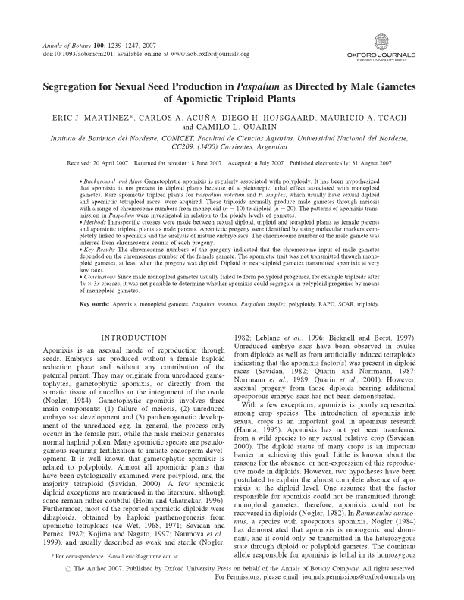
| dc.description.abstract | Background and Aims: Gametophytic apomixis is regularly associated with polyploidy. It has been hypothesized that apomixis is not present in diploid plants because of a pleiotropic lethal effect associated with monoploid gametes. Rare apomictic triploid plants for Paspalum notatum and P. simplex, which usually have sexual diploid and apomictic tetraploid races, were acquired. These triploids normally produce male gametes through meiosis with a range of chromosome numbers from monoploid (n = 10) to diploid (n = 20). The patterns of apomixis transmission in Paspalum were investigated in relation to the ploidy levels of gametes. Methods: Intraspecific crosses were made between sexual diploid, triploid and tetraploid plants as female parents and apomictic triploid plants as male parents. Apomictic progeny were identified by using molecular markers completely linked to apomixis and the analysis of mature embryo sacs. The chromosome number of the male gamete was inferred from chromosome counts of each progeny. Key Results: The chromosome numbers of the progeny indicated that the chromosome input of male gametes depended on the chromosome number of the female gamete. The apomictic trait was not transmitted through monoploid gametes, at least when the progeny was diploid. Diploid or near-diploid gametes transmitted apomixis at very low rates. Conclusions: Since male monoploid gametes usually failed to form polyploid progenies, for example triploids after 4x × 3x crosses, it was not possible to determine whether apomixis could segregate in polyploid progenies by means of monoploid gametes. | es |
| dc.format | application/pdf | es |
| dc.format.extent | p. 1239-1247 | es |
| dc.language.iso | eng | es |
| dc.publisher | Oxford University Press | es |
| dc.relation.uri | https://doi.org/10.1093/aob/mcm201 | es |
| dc.rights | openAccess | es |
| dc.rights.uri | http://creativecommons.org/licenses/by-nc-nd/2.5/ar/ | es |
| dc.source | Annals of Botany, 2007, vol. 100, no. 6, p. 1239-1247. | es |
| dc.subject | Apomixis | es |
| dc.subject | monoploid gametes | es |
| dc.subject | Paspalum notatum | es |
| dc.subject | Paspalum simplex | es |
| dc.subject | polyploidy | es |
| dc.subject | RAPD | es |
| dc.subject | SCAR | es |
| dc.subject | triploidy | es |
| dc.title | Segregation for sexual seed production in Paspalum as directed by male gametes of apomictic triploid plants | es |
| dc.type | Artículo | es |
| unne.affiliation | Fil: Martínez, Eric Javier. Universidad Nacional del Nordeste. Facultad de Ciencias Agrarias; Argentina. | es |
| unne.affiliation | Fil: Martínez, Eric Javier. Consejo Nacional de Investigaciones Científicas y Técnicas. Instituto de Botánica del Nordeste; Argentina. | es |
| unne.affiliation | Fil: Acuña, Carlos Alberto. Universidad Nacional del Nordeste. Facultad de Ciencias Agrarias; Argentina. | es |
| unne.affiliation | Fil: Acuña, Carlos Alberto. Consejo Nacional de Investigaciones Científicas y Técnicas. Instituto de Botánica del Nordeste; Argentina. | es |
| unne.affiliation | Fil: Hojsgaard, Diego Hernán. Universidad Nacional del Nordeste. Facultad de Ciencias Agrarias; Argentina. | es |
| unne.affiliation | Fil: Hojsgaard, Diego Hernán. Consejo Nacional de Investigaciones Científicas y Técnicas. Instituto de Botánica del Nordeste; Argentina. | es |
| unne.affiliation | Fil: Tcach, Mauricio Alejandro. Universidad Nacional del Nordeste. Facultad de Ciencias Agrarias; Argentina. | es |
| unne.affiliation | Fil: Tcach, Mauricio Alejandro. Consejo Nacional de Investigaciones Científicas y Técnicas. Instituto de Botánica del Nordeste; Argentina. | es |
| unne.affiliation | Fil: Quarin, Camilo Luis. Universidad Nacional del Nordeste. Facultad de Ciencias Agrarias; Argentina. | es |
| unne.affiliation | Fil: Quarin, Camilo Luis. Consejo Nacional de Investigaciones Científicas y Técnicas. Instituto de Botánica del Nordeste; Argentina. | es |
| unne.journal.pais | Reino Unido | es |
| unne.journal.ciudad | Oxford | es |
| unne.journal.volume | 100 | es |
| unne.journal.number | 6 | es |
| unne.ISSN-e | 1095-8290 | es |
Ficheros en el ítem
Este ítem aparece en la(s) siguiente(s) colección(ones)
-
Artículos de revista [541]

Excepto si se señala otra cosa, la licencia del ítem se describe comoopenAccess