








Mostrar el registro sencillo del ítem
Effect of pollination timing on the rate of apomictic reproduction revealed by RAPD Markers in Paspalum notatum
| dc.contributor.author | Espinoza, Francisco | |
| dc.contributor.author | Pessino, Silvina Claudia | |
| dc.contributor.author | Quarin, Camilo Luis | |
| dc.contributor.author | Valle, E. M. | |
| dc.date.accessioned | 2025-08-28T13:36:55Z | |
| dc.date.available | 2025-08-28T13:36:55Z | |
| dc.date.issued | 2002-02-01 | |
| dc.identifier.citation | Espinoza, Francisco, et al., 2002. Effect of pollination timing on the rate of apomictic reproduction revealed by RAPD Markers in Paspalum notatum. Annals of Botany. Oxford: Oxford University Press, vol. 89, no. 2, p. 165-170. E-ISSN 1095-8290. DOI https://doi.org/10.1093/aob/mcf024 | es |
| dc.identifier.issn | 0305-7364 | es |
| dc.identifier.uri | http://repositorio.unne.edu.ar/handle/123456789/58285 | |
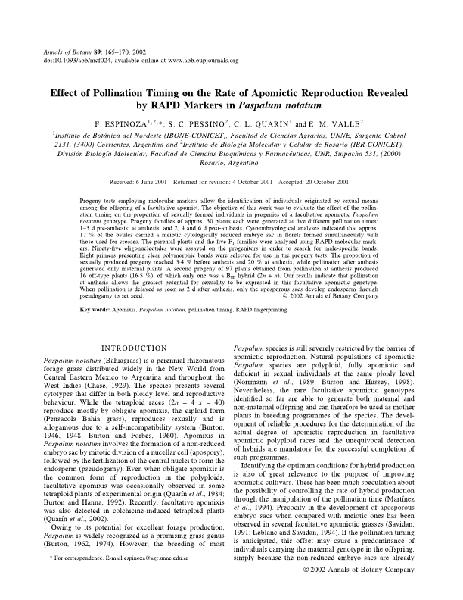
| dc.description.abstract | Progeny tests employing molecular markers allow the identification of individuals originated by sexual means among the offspring of a facultative apomict. The objective of this work was to evaluate the effect of the pollination timing on the proportion of sexually formed individuals in progenies of a facultative apomictic Paspalum notatum genotype. Progeny families of approx. 30 plants each were generated at five different pollination times: 1–3 d pre‐anthesis; at anthesis; and 2, 4 and 6 d post‐anthesis. Cytoembryological analyses indicated that approx. 17 % of the ovules carried a meiotic cytologically reduced embryo sac in florets formed simultaneously with those used for crosses. The parental plants and the five F1 families were analysed using RAPD molecular markers. Ninety‐five oligonucleotides were assayed on the progenitors in order to search for male‐specific bands. Eight primers presenting clear polymorphic bands were selected for use in the progeny tests. The proportion of sexually produced progeny reached 3·4 % before anthesis and 20 % at anthesis, while pollination after anthesis generated only maternal plants. A second progeny of 97 plants obtained from pollination at anthesis produced 16 off‐type plants (16·5 %), of which only one was a BIII hybrid (2n + n). Our results indicate that pollination at anthesis allows the greatest potential for sexuality to be expressed in this facultative apomictic genotype. When pollination is delayed as soon as 2 d after anthesis, only the aposporous sacs develop endosperm through pseudogamy to set seed. | es |
| dc.format | application/pdf | es |
| dc.format.extent | p. 165-170 | es |
| dc.language.iso | eng | es |
| dc.publisher | Oxford University Press | es |
| dc.relation.uri | https://doi.org/10.1093/aob/mcf024 | es |
| dc.rights | openAccess | es |
| dc.rights.uri | http://creativecommons.org/licenses/by-nc-nd/2.5/ar/ | es |
| dc.source | Annals of Botany, 2002, vol. 89, no. 2, p. 165-170. | es |
| dc.subject | Apomixis | es |
| dc.subject | Paspalum notatum | es |
| dc.subject | pollination timing | es |
| dc.subject | RAPD fingerprinting | es |
| dc.title | Effect of pollination timing on the rate of apomictic reproduction revealed by RAPD Markers in Paspalum notatum | es |
| dc.type | Artículo | es |
| unne.affiliation | Fil: Espinoza, Francisco. Consejo Nacional de Investigaciones Científicas y Técnicas. Instituto de Botánica del Nordeste; Argentina. | es |
| unne.affiliation | Fil: Espinoza, Francisco. Universidad Nacional de Rosario. Facultad de Ciencias Bioquímicas y Farmacéuticas; Argentina. | es |
| unne.affiliation | Fil: Pessino, Silvina Claudia. Consejo Nacional de Investigaciones Científicas y Técnicas. Instituto de Biología Molecular y Celular de Rosario; Argentina. | es |
| unne.affiliation | Fil: Pessino, Silvina Claudia. Universidad Nacional de Rosario. Facultad de Ciencias Bioquímicas y Farmacéuticas; Argentina. | es |
| unne.affiliation | Fil: Quarin, Camilo Luis. Consejo Nacional de Investigaciones Científicas y Técnicas. Instituto de Botánica del Nordeste; Argentina. | es |
| unne.affiliation | Fil: Quarin, Camilo Luis. Universidad Nacional del Nordeste. Facultad de Ciencias Agrarias; Argentina. | es |
| unne.affiliation | Fil: Valle, E. M. Consejo Nacional de Investigaciones Científicas y Técnicas. Instituto de Biología Molecular y Celular de Rosario; Argentina. | es |
| unne.affiliation | Fil: Valle, E. M. Universidad Nacional de Rosario. Facultad de Ciencias Bioquímicas y Farmacéuticas; Argentina. | es |
| unne.journal.pais | Reino Unido | es |
| unne.journal.ciudad | Oxford | es |
| unne.journal.volume | 89 | es |
| unne.journal.number | 2 | es |
| unne.ISSN-e | 1095-8290 | es |
Ficheros en el ítem
Este ítem aparece en la(s) siguiente(s) colección(ones)
-
Artículos de revista [541]

Excepto si se señala otra cosa, la licencia del ítem se describe comoopenAccess