







Mostrar el registro sencillo del ítem
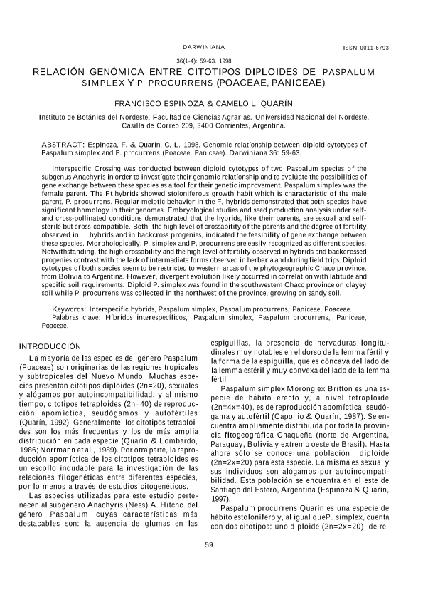
Relación genómica entre citotipos diploides de Paspalum simplex y P. procurrens (Poaceae, Paniceae)
| dc.contributor.author | Espinoza, Francisco | |
| dc.contributor.author | Quarin, Camilo Luis | |
| dc.date.accessioned | 2025-08-28T13:36:54Z | |
| dc.date.available | 2025-08-28T13:36:54Z | |
| dc.date.issued | 1998-09-25 | |
| dc.identifier.citation | Espinoza, Francisco y Quarin, Camilo Luis, 1998. Relación genómica entre citotipos diploides de Paspalum simplex y P. procurrens (Poaceae, Paniceae). Darwiniana, nueva serie. Buenos Aires: Instituto de Botánica Darwinion, vol. 36, no. 1-4, p. 59-63. ISSN 0011-6793. | es |
| dc.identifier.issn | 0011-6793 | es |
| dc.identifier.uri | http://repositorio.unne.edu.ar/handle/123456789/58283 | |
| dc.description.abstract | Interspecific Crossing was conducted between diploid cytotypes of two Paspalum species o f the subgenus Anachyris in order to investígate their genomic relatíonship and to evalúate the possibilities of gene exchange between these species as a tool for their genetic improvement. Paspalum simplex was the female parent. The Ft hybrids showed stoloniferous growth habit which is characteristíc of the male parent, P. procurrens. Regular meiotic behavior in the F, hybrids demonstrated that both species have significant homology in their genomes. Embryological studies and seed production analysis under self and cross-pollinated conditions demonstrated that the hybrids, like their parents, are sexual and selfsterile but cross-compatible. Both, the high level of crossabitity o f the parents and the degree of fertility observed in hybrids and in backcross progenies, indicated the feasibility of gene exchange between these species. Morphologically, P. simplex and P. procurrens are easily recognized as different species. Notwithstanding, the high crossability and the high level o f fertility observed in hybrids and backcrossed progenies contrast with the lack of intermedíate forms observed in herbaria and during field trips. Diploid cytotypes of both species seem to be restricted to western arcas of the phytogeographic Chaco province, from Bolivia to Argentina. However, divergent evolution likely occurred in correlation with latitude and specific soil requirements. Diploid P. simplex was found in the southwestem Chaco province on clayey soil while P. procurrens was collected in the northwest o f the province, growing on sandy soil. | es |
| dc.format | application/pdf | es |
| dc.format.extent | p. 59-63 | es |
| dc.language.iso | spa | es |
| dc.publisher | Instituto de Botánica Darwinion | es |
| dc.relation.uri | https://www.ojs.darwin.edu.ar/index.php/darwiniana/article/view/342 | es |
| dc.rights | openAccess | es |
| dc.rights.uri | http://creativecommons.org/licenses/by-nc-nd/2.5/ar/ | es |
| dc.source | Darwiniana, nueva serie, 1998, vol. 36, no. 1-4, p. 59-63. | es |
| dc.subject | Híbridos interespecíficos | es |
| dc.subject | Paspalum simplex | es |
| dc.subject | Paspalum procurrens | es |
| dc.subject | Paniceae | es |
| dc.subject | Interspecific hybrids | es |
| dc.subject | Paspalum simplex | es |
| dc.subject | Paspalum procurrens | es |
| dc.subject | Paniceae | es |
| dc.subject | Poaceae | es |
| dc.title | Relación genómica entre citotipos diploides de Paspalum simplex y P. procurrens (Poaceae, Paniceae) | es |
| dc.type | Artículo | es |
| unne.affiliation | Fil: Espinoza, Francisco. Universidad Nacional del Nordeste. Facultad de Ciencias Agrarias; Argentina. | es |
| unne.journal.pais | Argentina | es |
| unne.journal.ciudad | Buenos Aires | es |
| unne.journal.volume | 36 | es |
| unne.journal.number | 1-4 | es |
| unne.ISSN-e | 1850-1699 | es |
Ficheros en el ítem
Este ítem aparece en la(s) siguiente(s) colección(ones)
-
Artículos de revista [541]

Excepto si se señala otra cosa, la licencia del ítem se describe comoopenAccess
Ítems relacionados
Mostrando ítems relacionados por Título, autor o materia.
-
Hibridación interespecífica entre Paspalum urvillei y el grupo Paniculata de Paspalum (Poaceae)
(Sociedad Argentina de Botánica, 2023-09-19)La hibridación y la poliploidía son factores evolutivos exponenciales para la biodiversidad. Algunas especies de Paspalum pueden hibridar y originar alopoliploides viables y fértiles. Un híbrido resistente a heladas fue ... -
Análisis de híbridos interespecíficos de Paspalum indecor y Paspalum pumilum
(Sociedad Argentina de Botánica, 2023-09-19)Paspalum indecorum Mez (Poaceae) es una especie que pertenece al grupo informal Caespitosa. El ci- totipo diploide (2n= 2x= 20) es sexual y autoéstéril. Por otro lado, Paspalum pumilum Nees pertenece al grupo informal ... -
Agronomic characterization of paspalum atratum swallen and P. lenticulare kunth
(International Center for Tropical Agriculture (CIAT), 2018-05-31)Paspalum atratum and P. lenticulare are perennial grasses, native to South America. The objective was to evaluate seasonal growth, frost tolerance, cattle preference, nutritional characteristics, seed yield and germination ...