








Control químico del falso carbón en diferentes estados fenológicos del cultivo de arroz
Chemical control of rice false smut at different growth stages of rice crop
Fecha
2021-01Metadatos
Mostrar el registro completo del ítemResumen
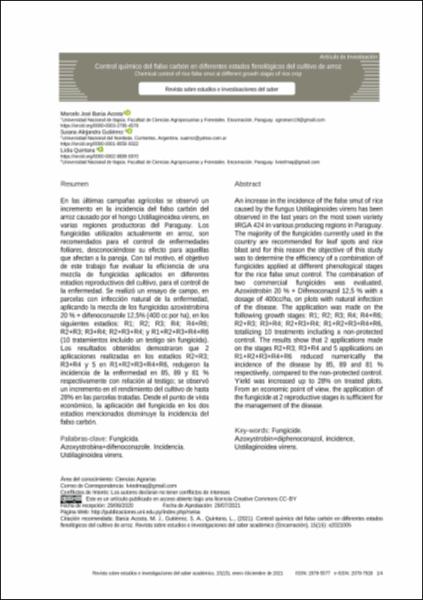
En las últimas campañas agrícolas se observó un
incremento en la incidencia del falso carbón del
arroz causado por el hongo Ustilaginoidea virens, en
varias regiones productoras del Paraguay. Los
fungicidas utilizados actualmente en arroz, son
recomendados para el control de enfermedades
foliares, desconociéndose su efecto para aquellas
que afectan a la panoja. Con tal motivo, el objetivo
de este trabajo fue evaluar la eficiencia de una
mezcla de fungicidas aplicados en diferentes
estadios reproductivos del cultivo, para el control de
la enfermedad. Se realizó un ensayo de campo, en
parcelas con infección natural de la enfermedad,
aplicando la mezcla de los fungicidas azoxistrobina
20 % + difenoconazole 12,5% (400 cc por ha), en los
siguientes estadios: R1; R2; R3; R4; R4+R6;
R2+R3; R3+R4; R2+R3+R4; y R1+R2+R3+R4+R6
(10 tratamientos incluido un testigo sin fungicida).
Los resultados obtenidos demostraron que 2
aplicaciones realizadas en los estadios R2+R3;
R3+R4 y 5 en R1+R2+R3+R4+R6, redujeron la
incidencia de la enfermedad en 85, 89 y 81 %
respectivamente con relación al testigo; se observó
un incremento en el rendimiento del cultivo de hasta
28% en las parcelas tratadas. Desde el punto de vista
económico, la aplicación del fungicida en los dos
estadios mencionados disminuye la incidencia del
falso carbón. An increase in the incidence of the false smut of rice
caused by the fungus Ustilaginoides virens has been
observed in the last years on the most sown variety
IRGA 424 in various producing regions in Paraguay.
The majority of the fungicides currently used in the
country are recommended for leaf spots and rice
blast and for this reason the objective of this study
was to determine the efficiency of a combination of
fungicides applied at different phenological stages
for the rice false smut control. The combination of
two commercial fungicides was evaluated,
Azoxistrobin 20 % + Difenoconazol 12,5 % with a
dosage of 400cc/ha, on plots with natural infection
of the disease. The application was made on the
following growth stages: R1; R2; R3; R4; R4+R6;
R2+R3; R3+R4; R2+R3+R4; R1+R2+R3+R4+R6,
totalizing 10 treatments including a non-protected
control. The results show that 2 applications made
on the stages R2+R3; R3+R4 and 5 applications on
R1+R2+R3+R4+R6 reduced numerically the
incidence of the disease by 85, 89 and 81 %
respectively, compared to the non-protected control.
Yield was increased up to 28% on treated plots.
From an economic point of view, the application of
the fungicide at 2 reproductive stages is sufficient for
the management of the disease.
Colecciones
- Artículos de revista [541]

Excepto si se señala otra cosa, la licencia del ítem se describe comoopenAccess