







Una lectura de las influencias filosóficas : Nietzsche y Foucault
Fecha
2005-11-14Metadatos
Mostrar el registro completo del ítemResumen
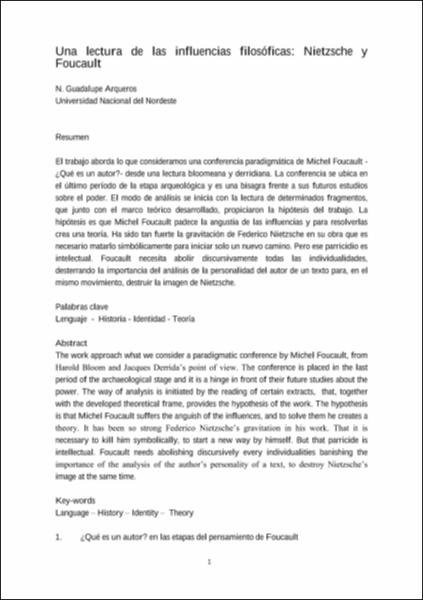
El trabajo aborda lo que consideramos una conferencia paradigmática de Michel Foucault -
¿Qué es un autor?- desde una lectura bloomeana y derridiana. La conferencia se ubica en
el último período de la etapa arqueológica y es una bisagra frente a sus futuros estudios
sobre el poder. El modo de análisis se inicia con la lectura de determinados fragmentos,
que junto con el marco teórico desarrollado, propiciaron la hipótesis del trabajo. La
hipótesis es que Michel Foucault padece la angustia de las influencias y para resolverlas
crea una teoría. Ha sido tan fuerte la gravitación de Federico Nietzsche en su obra que es
necesario matarlo simbólicamente para iniciar solo un nuevo camino. Pero ese parricidio es
intelectual. Foucault necesita abolir discursivamente todas las individualidades,
desterrando la importancia del análisis de la personalidad del autor de un texto para, en el
mismo movimiento, destruir la imagen de Nietzsche. The work approach what we consider a paradigmatic conference by Michel Foucault, from
Harold Bloom and Jacques Derrida’s point of view. The conference is placed in the last
period of the archaeological stage and it is a hinge in front of their future studies about the
power. The way of analysis is initiated by the reading of certain extracts, that, together
with the developed theoretical frame, provides the hypothesis of the work. The hypothesis
is that Michel Foucault suffers the anguish of the influences, and to solve them he creates a
theory. It has been so strong Federico Nietzsche’s gravitation in his work. That it is
necessary to kill him symbolically, to start a new way by himself. But that parricide is
intellectual. Foucault needs abolishing discursively every individualities banishing the
importance of the analysis of the author’s personality of a text, to destroy Nietzsche’s
image at the same time.
Colecciones
- Artículos de revista [1419]

Excepto si se señala otra cosa, la licencia del ítem se describe comoopenAccess