








Mostrar el registro sencillo del ítem
Phylogenetic relationships within turneraceae based on morphological characters with emphasis on seed micromorphology
| dc.contributor.author | Arbo, María Mercedes | |
| dc.contributor.author | González, Ana María | |
| dc.contributor.author | Sede, Silvana Mabel | |
| dc.date.accessioned | 2022-06-07T15:55:39Z | |
| dc.date.available | 2022-06-07T15:55:39Z | |
| dc.date.issued | 2015-03-31 | |
| dc.identifier.citation | Arbo, María Mercedes, González, Ana María y Sede, Silvana Mabel, 2015. Phylogenetic relationships within turneraceae based on morphological characters with emphasis on seed micromorphology. Plant Systematics and Evolution. Berlin: Springer Nature, vol. 301, p. 1907-1926. ISSN-e 1615-6110. | es |
| dc.identifier.issn | 0378-2697 | es |
| dc.identifier.uri | http://repositorio.unne.edu.ar/handle/123456789/48043 | |
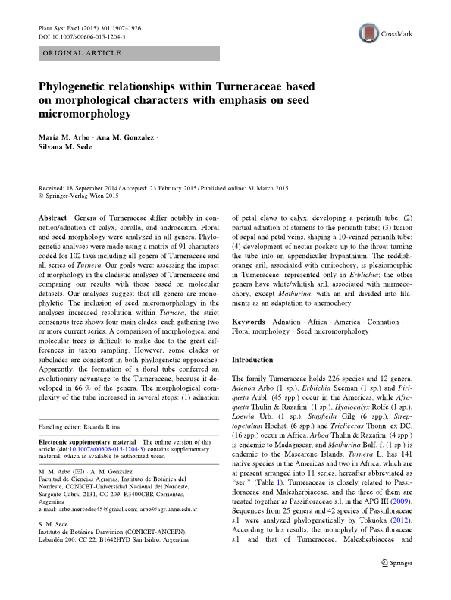
| dc.description.abstract | Genera of Turneraceae differ notably in connation/adnation of calyx, corolla, and androecium. Floral and seed morphology were analyzed in all genera. Phylogenetic analyses were made using a matrix of 91 characters coded for 102 taxa including all genera of Turneraceae and all series of Turnera. Our goals were: assessing the impact of morphology in the cladistic analyses of Turneraceae and comparing our results with those based on molecular datasets. Our analyses suggest that all genera are monophyletic. The inclusion of seed micromorphology in the analyses increased resolution within Turnera, the strict consensus tree shows four main clades, each gathering two or more current series. A comparison of morphological and molecular trees is difficult to make due to the great differences in taxon sampling. However, some clades or subclades are consistent in both phylogenetic approaches. Apparently, the formation of a floral tube conferred an evolutionary advantage to the Turneraceae, because it developed in 66 % of the genera. The morphological complexity of the tube increased in several steps: (1) adnation of petal claws to calyx, developing a perianth tube; (2) partial adnation of stamens to the perianth tube; (3) fusion of sepal and petal veins, shaping a 10-veined perianth tube; (4) development of nectar pockets up to the throat turning the tube into an appendicular hypanthium. The reddishorange aril, associated with ornitochory, is plesiomorphic in Turneraceae, represented only in Erblichia; the other genera have white/whitish aril, associated with mirmecochory, except Mathurina, with an aril divided into filaments as an adaptation to anemochory. | es |
| dc.format | application/pdf | es |
| dc.language.iso | eng | es |
| dc.publisher | Springer Nature | es |
| dc.relation.uri | https://link.springer.com/article/10.1007/s00606-015-1204-3 | |
| dc.rights | openAccess | es |
| dc.rights.uri | http://creativecommons.org/licenses/by-nc-nd/2.5/ar/ | es |
| dc.source | Plant Systematics and Evolution, 2015, vol. 301, p. 1907-1926. | es |
| dc.subject | Adnation | es |
| dc.subject | Africa | es |
| dc.subject | América | es |
| dc.subject | Connation | es |
| dc.subject | Floral morphology | es |
| dc.subject | Seed micromorphology | es |
| dc.title | Phylogenetic relationships within turneraceae based on morphological characters with emphasis on seed micromorphology | es |
| dc.type | Artículo | es |
| unne.affiliation | Fil: Arbo, María Mercedes. Universidad Nacional del Nordeste. Facultad de Ciencias Agrarias; Argentina. | es |
| unne.affiliation | Fil: Arbo, María Mercedes. Consejo Nacional de Investigaciones Científicas y Técnicas. Instituto de Botánica del Nordeste; Argentina. | es |
| unne.affiliation | Fil: González, Ana María. Universidad Nacional del Nordeste. Facultad de Ciencias Agrarias; Argentina. | es |
| unne.affiliation | Fil: González, Ana María. Consejo Nacional de Investigaciones Científicas y Técnicas. Instituto de Botánica del Nordeste; Argentina. | es |
| unne.affiliation | Fil: Sede, Silvana Mabel. Consejo Nacional de Investigaciones Científicas y Técnicas. Instituto de Botánica Darwinion; Argentina. | es |
| unne.journal.pais | Alemania | es |
| unne.journal.ciudad | Berlin | es |
| unne.ISSN-e | 1615-6110 | es |
Ficheros en el ítem
Este ítem aparece en la(s) siguiente(s) colección(ones)
-
Artículos de revista [541]

Excepto si se señala otra cosa, la licencia del ítem se describe comoopenAccess