





Mostrar el registro sencillo del ítem
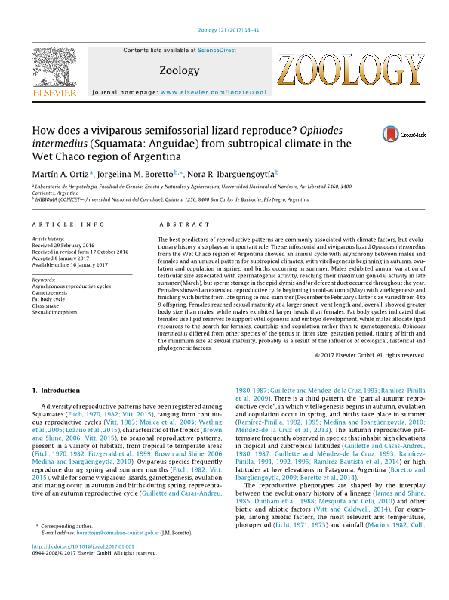
How does a viviparous semifossorial lizard reproduce? Ophiodesintermedius (squamata : anguidae) from subtropical climate in theWet Chaco region of Argentina
| dc.contributor.author | Ortíz, Martín Alejandro | |
| dc.contributor.author | Boretto, Jorgelina Mariela | |
| dc.contributor.author | Ibargüengoytía, Nora Ruth | |
| dc.date.accessioned | 2021-11-15T17:08:51Z | |
| dc.date.available | 2021-11-15T17:08:51Z | |
| dc.date.issued | 2017 | |
| dc.identifier.citation | Ortíz, Martín Alejandro, Boretto, Jorgelina Mariela y Ibargüengoytía, Nora Ruth, 2017. How does a viviparous semifossorial lizard reproduce? Ophiodesintermedius (squamata : anguidae) from subtropical climate in theWet Chaco region of Argentina. Zoology. Ámsterdan : Elseiver, vol. 121, p. 35-43. ISSN 0944-2006. | es |
| dc.identifier.uri | http://repositorio.unne.edu.ar/handle/123456789/30109 | |
| dc.description.abstract | The best predictors of reproductive patterns are commonly associated with climate factors, but evolu-tionary history also plays an important role. The semifossorial and viviparous lizard Ophiodes intermediusfrom the Wet Chaco region of Argentina showed an annual cycle with asynchrony between males andfemales and an unusual pattern for subtropical climates, with vitellogenesis beginning in autumn, ovu-lation and copulation in spring, and births occurring in summer. Males exhibited annual variation oftesticular size associated with spermatogenic activity, reaching their maximum gonadal activity in latesummer (March), but sperm storage in the epididymis and/or deferent duct occurred throughout the year.Females showed an extended reproductive cycle beginning in mid-autumn (May) with vitellogenesis andfinishing with births from late spring to mid-summer (December to February). Litter size varied from 4 to9 offspring. Females reached sexual maturity at a larger snout–vent length and, overall, showed greaterbody size than males, while males exhibited larger heads than females. Fat body cycles indicated thatfemales use lipid reserves to support vitellogenesis and embryo development, while males allocate lipidresources to the search for females, courtship and copulation rather than to gametogenesis. Ophiodesintermedius differed from other species of the genus in litter size, gestation period, timing of birth andthe minimum size at sexual maturity, probably as a result of the influence of ecological, historical andphylogenetic factors. | es |
| dc.format | application/pdf | es |
| dc.language.iso | eng | es |
| dc.publisher | Elsevier | es |
| dc.rights | openAccess | es |
| dc.rights.uri | http://creativecommons.org/licenses/by-nc-nd/2.5/ar/ | es |
| dc.source | Zoology, 2017, vol. 121, p. 35-43. | es |
| dc.subject | Asynchronous reproductive cycles | es |
| dc.subject | Gametogenesis | es |
| dc.subject | Fat body cycle | es |
| dc.subject | Glass snake | es |
| dc.subject | Sexual dimorphisma | es |
| dc.title | How does a viviparous semifossorial lizard reproduce? Ophiodesintermedius (squamata : anguidae) from subtropical climate in theWet Chaco region of Argentina | es |
| dc.type | Artículo | es |
| unne.affiliation | Fil: Ortíz, Martín Alejandro. Universidad Nacional del Nordeste. Facultad de Ciencias Exacta y Naturales y Agrimensura; Argentina. | es |
| unne.affiliation | Fil: Boretto, Jorgelina Mariela. Consejo Nacional de Investigaciones Científicas y Técnicas. Instituto de Investigaciones en Biodiversidad y Medio Ambiente; Argentina. | es |
| unne.affiliation | Fil: Ibargüengoytía, Nora Ruth. Consejo Nacional de Investigaciones Científicas y Técnicas. Instituto de Investigaciones en Biodiversidad y Medio Ambiente; Argentina | es |
| unne.journal.pais | Países Bajo | es |
| unne.journal.ciudad | Ámsterdam | es |
| unne.ISSN-e | 0944-2006 | es |
Ficheros en el ítem
Este ítem aparece en la(s) siguiente(s) colección(ones)
-
Artículos de revista [872]

Excepto si se señala otra cosa, la licencia del ítem se describe comoopenAccess