








Breeding tetraploid Paspalum simplex : hybridization, early identification of apomicts, and impact of apomixis on hybrid performance
Fecha
2019-03Metadatos
Mostrar el registro completo del ítemResumen
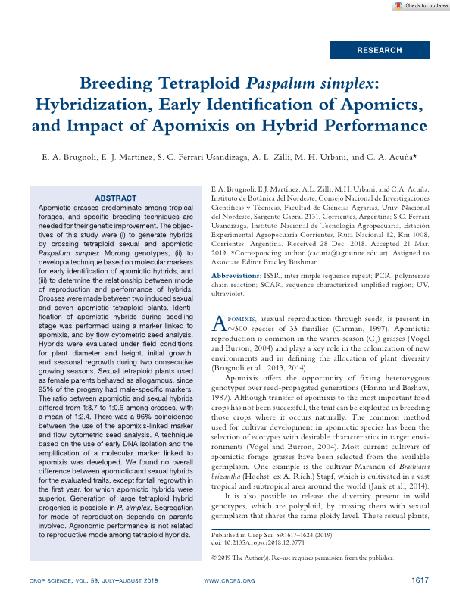
Apomictic grasses predominate among tropical forages, and specific breeding techniques are
needed for their genetic improvement. The objectives of this study were (i) to generate hybrids
by crossing tetraploid sexual and apomictic Paspalum simplex Morong genotypes, (ii) to
develop a technique based on molecular markers for early identification of apomictic hybrids, and
(iii) to determine the relationship between mode of reproduction and performance of hybrids.
Crosses were made between two induced sexual and seven apomictic tetraploid plants. Identi-
fication of apomictic hybrids during seedling stage was performed using a marker linked to
apomixis, and by flow cytometric seed analysis.
Hybrids were evaluated under field conditions for plant diameter and height, initial growth,
and seasonal regrowth during two consecutive growing seasons. Sexual tetraploid plants used
as female parents behaved as allogamous, since 95% of the progeny had male-specific markers.
The ratio between apomictic and sexual hybrids differed from 1:8.7 to 1:0.6 among crosses, with
a mean of 1:2.4. There was a 96% coincidence between the use of the apomixis-linked marker
and flow cytometric seed analysis. A technique based on the use of early DNA isolation and the
amplification of a molecular marker linked to apomixis was developed. We found no overall
difference between apomictic and sexual hybrids for the evaluated traits, except for fall regrowth in
the first year, for which apomictic hybrids were superior. Generation of large tetraploid hybrid
progenies is possible in P. simplex. Segregation for mode of reproduction depends on parents
involved. Agronomic performance is not related to reproductive mode among tetraploid hybrids.
Colecciones
- Artículos de revista [543]

Excepto si se señala otra cosa, la licencia del ítem se describe comoclosedAccess