








Mostrar el registro sencillo del ítem
Perianth organs in Nymphaeaceae : comparative study on epidermal and structural characters
| dc.contributor.author | Zini, Lucía Melisa | |
| dc.contributor.author | Galati, Beatriz Gloria | |
| dc.contributor.author | Ferrucci, María Silvia | |
| dc.date.accessioned | 2025-12-15T11:33:05Z | |
| dc.date.available | 2025-12-15T11:33:05Z | |
| dc.date.issued | 2017-07-21 | |
| dc.identifier.citation | Zini, Lucía Melisa, Galati, Beatriz Gloria y Ferrucci, María Silvia, 2017. Perianth organs in Nymphaeaceae : comparative study on epidermal and structural characters. Journal of Plant Research. Sakai: Sociedad Botánica de Japón, vol. 130, p. 1047-1060. E-ISSN 1618-0860. DOI https://doi.org/10.1007/s10265-017-0963-z | es |
| dc.identifier.issn | 0918-9440 | es |
| dc.identifier.uri | http://repositorio.unne.edu.ar/handle/123456789/59375 | |
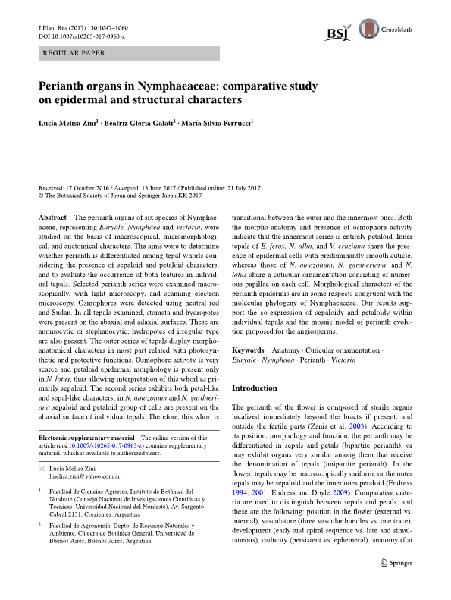
| dc.description.abstract | The perianth organs of six species of Nymphaeaceae, representing Euryale, Nymphaea and Victoria, were studied on the basis of macroscopical, micromorphological, and anatomical characters. The aims were to determine whether perianth is differentiated among tepal whorls considering the presence of sepaloid and petaloid characters, and to evaluate the occurrence of both features in individual tepals. Selected perianth series were examined macroscopically, with light microscopy, and scanning electron microscopy. Osmophores were detected using neutral red and Sudan. In all tepals examined, stomata and hydropotes were present on the abaxial and adaxial surfaces. These are anomocytic or stephanocytic; hydropotes of irregular type are also present. The outer series of tepals display morphoanatomical characters in most part related with photosynthetic and protective functions. Osmophore activity is very scarce and petaloid epidermal morphology is present only in N. lotus, thus allowing interpretation of this whorl as primarily sepaloid. The second series exhibits both petal-like and sepal-like characters; in N. amazonum and N. gardneriana sepaloid and petaloid group of cells are present on the abaxial surface of individual tepals. Therefore, this whorl is transitional between the outer and the innermost ones. Both the morpho-anatomy and presence of osmophore activity indicate that the innermost series is entirely petaloid. Inner tepals of E. ferox, N. alba, and V. cruziana share the presence of epidermal cells with predominantly smooth cuticle, whereas those of N. amazonum, N. gardneriana, and N. lotus share a cuticular ornamentation consisting of numerous papillae on each cell. Morphological characters of the perianth epidermis are in some respects congruent with the molecular phylogeny of Nymphaeaceae. Our results support the co-expression of sepaloidy and petaloidy within individual tepals and the mosaic model of perianth evolution proposed for the angiosperms. | en |
| dc.format | application/pdf | es |
| dc.format.extent | p. 1047-1060 | es |
| dc.language.iso | en | es |
| dc.publisher | Sociedad Botánica de Japón | es |
| dc.relation.uri | https://doi.org/10.1007/s10265-017-0963-z | es |
| dc.rights | restrictedAccess | es |
| dc.rights.uri | http://creativecommons.org/licenses/by-nc-nd/2.5/ar/ | es |
| dc.source | Journal of Plant Research, 2017, vol. 130, p. 1047-1060. | es |
| dc.subject | Anatomy | en |
| dc.subject | Cuticular ornamentation | en |
| dc.subject | Euryale | en |
| dc.subject | Nymphaea | en |
| dc.subject | Perianth | en |
| dc.subject | Victoria | en |
| dc.title | Perianth organs in Nymphaeaceae : comparative study on epidermal and structural characters | en |
| dc.type | Artículo | es |
| unne.affiliation | Fil: Zini, Lucía Melisa. Universidad Nacional del Nordeste. Facultad de Ciencias Agrarias; Argentina. | es |
| unne.affiliation | Fil: Galati, Beatriz Gloria. Universidad de Buenos Aires. Facultad de Agronomía; Argentina. | es |
| unne.affiliation | Fil: Ferrucci, María Silvia. Universidad Nacional del Nordeste. Facultad de Ciencias Agrarias; Argentina. | es |
| unne.journal.pais | Japón | es |
| unne.journal.ciudad | Sakai | es |
| unne.journal.volume | 130 | es |
| unne.ISSN-e | 1618-0860 | es |
Ficheros en el ítem
Este ítem aparece en la(s) siguiente(s) colección(ones)
-
Artículos de revista [541]

Excepto si se señala otra cosa, la licencia del ítem se describe comorestrictedAccess