






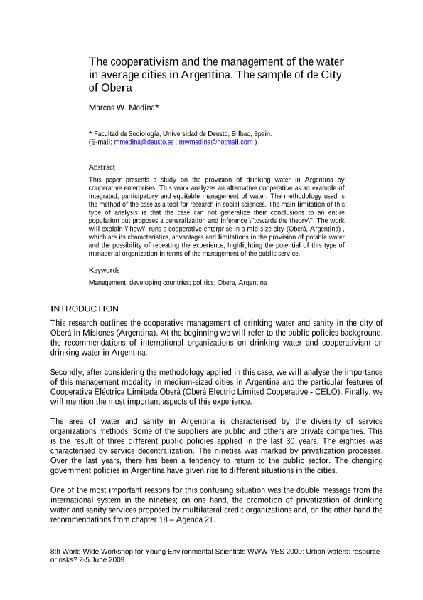
The cooperativism and the management of the water in average cities in Argentina. The sample of de city of Obera
Fecha
2009-06-05Metadatos
Mostrar el registro completo del ítemResumen
This paper presents a study on the provision of drinking water in Argentina by
cooperative enterprises. This work analyzes an alternative cooperative as an example of
integrated, participatory and equitable management of water. The methodology used is
the method of the case as a tool for research in social sciences. The main limitation of this
type of analysis is that the case can not generalize their conclusions to an entire
population but proposes a generalization and inference \"towards the theory\". The work
will explain \"how\" runs a cooperative enterprise in a mid-size city (Oberá, Argentina) ,
which are its characteristics, advantages and limitations in the provision of potable water
and the possibility of repeating the experience, highlighting the potential of this type of
managerial organization in terms of the management of the public service.
Colecciones
- Documentos de conferencia [1476]

Excepto si se señala otra cosa, la licencia del ítem se describe comoopenAccess