





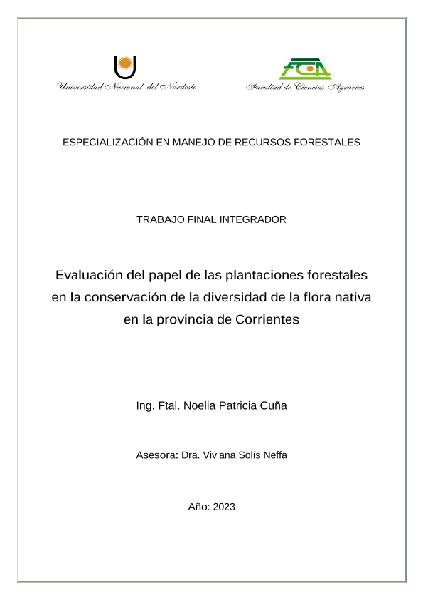
Evaluación del papel de las plantaciones forestales en la conservación de la diversidad de la flora nativa en la provincia de Corrientes
Resumen
Corrientes posee la mayor superficie forestada del país. El manejo sustentable integral de
estos sistemas productivos puede resultar de importancia para la conservación de la
biodiversidad. En este contexto, el objetivo del presente trabajo fue analizar, a escala de
paisaje, la riqueza de la flora nativa, así como la cantidad y condición de las especies en
riesgo en las diferentes ecorregiones y cuencas forestales de la provincia mediante
herramientas de SIG. Los resultados mostraron que la flora vascular de Corrientes incluye
2782 especies (2077 nativas y 495 endémicas) de 170 familias, siendo Poaceae y Asteraceae
las más representadas. Las ecorregiones Esteros del Iberá y Campos y Malezales, que se
superponen parcialmente con las Cuencas Forestales Centro y Noreste, presentan el mayor
número de especies y familias de plantas vasculares, además del mayor número de especies
endémicas. Los mapas de calor obtenidos mostraron que la información acerca de la
tendencia y riesgo de la biodiversidad en las diferentes ecorregiones y cuencas forestales de
Corrientes es fragmentaria, existiendo importantes vacíos de conocimiento. Los datos
recopilados ofrecen una visión detallada de la diversidad florística de Corrientes, y constituye
la base para valorizar el papel de las forestaciones en la conservación de la biodiversidad. Corrientes has the largest forested area in the country. The comprehensive sustainable
management of these productive systems can be important for biodiversity conservation. In
this context, the aim of this study was to analyze, at a landscape scale, the richness of native
flora, as well as the quantity and condition of endangered species in different ecoregions and
forest basins of the province using GIS tools. The results showed that Corrientes' vascular
flora includes 2,782 species (2,077 native and 495 endemic) from 170 families, with Poaceae
and Asteraceae being the most represented. The Esteros del Iberá and Campos y Malezales
ecoregions, which partially overlap with the Centro and Noreste forest basins, have the highest
number of vascular plant species and families, as well as the highest number of endemic
species. Heat maps obtained showed that information about the trend and risk of biodiversity
in different ecoregions and forest basins of Corrientes is fragmented, with significant
knowledge gaps. The collected data provide a detailed view of the floristic diversity of
Corrientes and form the basis for valuing the role of forested areas in biodiversity conservation.
Colecciones

Excepto si se señala otra cosa, la licencia del ítem se describe comoopenAccess