








Mostrar el registro sencillo del ítem
Genetic characterization of local Criollo pig breeds from the Americas using microsatellite markers
| dc.contributor.author | Revidatti, María Antonia Susana | |
| dc.contributor.author | Delgado Bermejo, Juan Vicente | |
| dc.contributor.author | Telo Da Gama, Luis Lavandhino | |
| dc.contributor.author | Landi Periati, Vincenzo | |
| dc.contributor.author | Ginja, Catarina | |
| dc.contributor.author | Álvarez, Luz Angela | |
| dc.contributor.author | Vega-Pla, José Luis | |
| dc.contributor.author | Martínez Martínez, Amparo | |
| dc.contributor.author | BioPig Consortium | |
| dc.date.accessioned | 2024-06-10T12:14:44Z | |
| dc.date.available | 2024-06-10T12:14:44Z | |
| dc.date.issued | 2014-11 | |
| dc.identifier.citation | Revidatti, María Antonia Susana, et al., 2014. Genetic characterization of local Criollo pig breeds from the Americas using microsatellite markers. Journal of Animal Science. Champaign: American Society of Animal Science, vol. 92, no. 11, p. 4823-4832. E-ISSN: 1525-3163. | es |
| dc.identifier.uri | http://repositorio.unne.edu.ar/handle/123456789/54236 | |
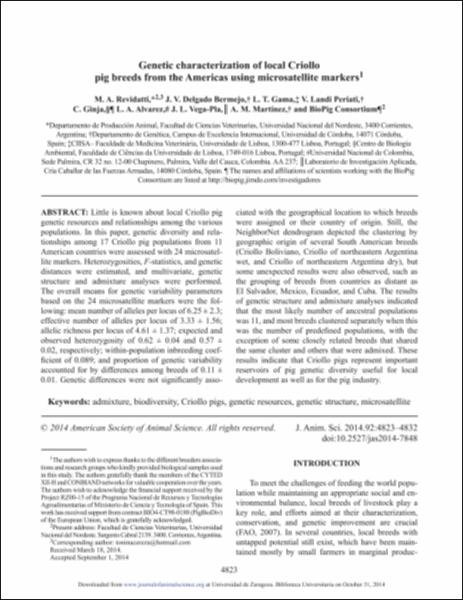
| dc.description.abstract | Little is known about local Criollo pig genetic resources and relationships among the various populations. In this paper, genetic diversity and relationships among 17 Criollo pig populations from 11 American countries were assessed with 24 microsatellite markers. Heterozygosities, F-statistics, and genetic distances were estimated, and multivariate, genetic structure and admixture analyses were performed. The overall means for genetic variability parameters based on the 24 microsatellite markers were the following: mean number of alleles per locus of 6.25 ± 2.3; effective number of alleles per locus of 3.33 ± 1.56; allelic richness per locus of 4.61 ± 1.37; expected and observed heterozygosity of 0.62 ± 0.04 and 0.57 ± 0.02, respectively; within-population inbreeding coefficient of 0.089; and proportion of genetic variability accounted for by differences among breeds of 0.11 ± 0.01. Genetic differences were not significantly associated with the geographical location to which breeds were assigned or their country of origin. Still, the NeighborNet dendrogram depicted the clustering by geographic origin of several South American breeds (Criollo Boliviano, Criollo of northeastern Argentina wet, and Criollo of northeastern Argentina dry), but some unexpected results were also observed, such as the grouping of breeds from countries as distant as El Salvador, Mexico, Ecuador, and Cuba. The results of genetic structure and admixture analyses indicated that the most likely number of ancestral populations was 11, and most breeds clustered separately when this was the number of predefined populations, with the exception of some closely related breeds that shared the same cluster and others that were admixed. These results indicate that Criollo pigs represent important reservoirs of pig genetic diversity useful for local development as well as for the pig industry. | es |
| dc.format | application/pdf | es |
| dc.format.extent | p. 4823-4832 | es |
| dc.language.iso | eng | es |
| dc.publisher | American Society of Animal Science | es |
| dc.relation.uri | https://doi.org/10.2527/jas.2014-7848 | es |
| dc.rights | openAccess | es |
| dc.rights.uri | http://creativecommons.org/licenses/by-nc-nd/2.5/ar/ | es |
| dc.source | Journal of Animal Science, 2014, vol. 92, no. 11, p. 4823-4832. | es |
| dc.subject | Admixture | es |
| dc.subject | Biodiversity | es |
| dc.subject | Criollo pigs | es |
| dc.subject | Genetic resources | es |
| dc.subject | Genetic structure | es |
| dc.subject | Microsatellite | es |
| dc.title | Genetic characterization of local Criollo pig breeds from the Americas using microsatellite markers | es |
| dc.type | Artículo | es |
| unne.affiliation | Fil: Revidatti, María Antonia Susana. Universidad Nacional del Nordeste. Facultad de Ciencias Veterinarias; Argentina. | es |
| unne.affiliation | Fil: Delgado Bermejo, Juan Vicente. Universidad Nacional del Nordeste. Facultad de Ciencias Veterinarias; Argentina. | es |
| unne.affiliation | Fil: Delgado Bermejo, Juan Vicente. Universidad de Córdoba. Departamento de Genética; España. | es |
| unne.affiliation | Fil: Telo Da Gama, Luis Lavandhino. Universidade de Lisboa. Faculdade de Medicina Veterinária; Portugal. | es |
| unne.affiliation | Fil: Landi Periati, Vincenzo. Universidad de Córdoba. Departamento de Genética; España. | es |
| unne.affiliation | Fil: Ginja, Catarina. Universidade de Lisboa. Faculdade de Ciências; Portugal. | es |
| unne.affiliation | Fil: Álvarez, Luz Angela. Universidad Nacional de Colombia. Facultad de Ciencias Agropecuarias; Colombia. | es |
| unne.affiliation | Fil: Vega-Pla, José Luis. Ministerio de Defensa. Laboratorio de Investigación Aplicada; España. | es |
| unne.affiliation | Fil: Martínez Martínez, Amparo. Universidad de Córdoba. Departamento de Genética; España. | es |
| unne.journal.pais | Estados Unidos | es |
| unne.journal.ciudad | Champaign | es |
| unne.journal.volume | 92 | es |
| unne.journal.number | 11 | es |
| unne.ISSN-e | 1525-3163 | es |
Ficheros en el ítem
Este ítem aparece en la(s) siguiente(s) colección(ones)
-
Artículos de revista [474]

Excepto si se señala otra cosa, la licencia del ítem se describe comoopenAccess