







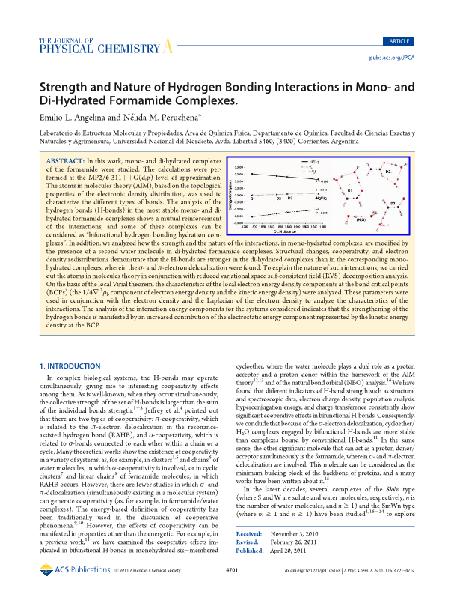
Strength and nature of hydrogen bonding interactions in mono-and di-hydrated formamide complexes
Fecha
2011Metadatos
Mostrar el registro completo del ítemResumen
In this work, mono- and di-hydrated complexes
of the formamide were studied. The calculations were performed
at the MP2/6-311þþG(d,p) level of approximation.
The atoms in molecules theory (AIM), based on the topological
properties of the electronic density distribution, was used to
characterize the different types of bonds. The analysis of the
hydrogen bonds (H-bonds) in the most stable mono- and dihydrated
formamide complexes shows a mutual reinforcement
of the interactions, and some of these complexes can be
considered as “bifunctional hydrogen bonding hydration complexes”.
In addition, we analyzed how the strength and the nature of the interactions, in mono-hydrated complexes, are modified by
the presence of a second water molecule in di-hydrated formamide complexes. Structural changes, cooperativity, and electron
density redistributions demonstrate that the H-bonds are stronger in the di-hydrated complexes than in the corresponding monohydrated
complexes, wherein the σ- and π-electron delocalization were found. To explain the nature of such interactions, we carried
out the atoms inmolecules theory in conjunction with reduced variational space self-consistent field (RVS) decomposition analysis.
On the basis of the local Virial theorem, the characteristics of the local electron energy density components at the bond critical points
(BCPs) (the 1/4r2Fb component of electron energy density and the kinetic energy density) were analyzed. These parameters were
used in conjunction with the electron density and the Laplacian of the electron density to analyze the characteristics of the
interactions. The analysis of the interaction energy components for the systems considered indicates that the strengthening of the
hydrogen bonds is manifested by an increased contribution of the electrostatic energy component represented by the kinetic energy
density at the BCP.
Colecciones
- Artículos de revista [851]

Excepto si se señala otra cosa, la licencia del ítem se describe comoopenAccess