







Facultad de Ciencias Exactas y Naturales y Agrimensura: Envíos recientes
Mostrando ítems 2141-2160 de 2379
-
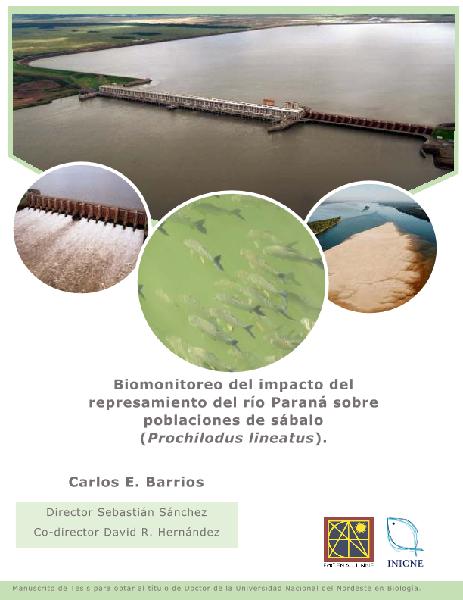
Biomonitoreo del impacto del represamiento del río Paraná sobre la poblaciones de sábalo (prochilodus lineatus)
(Universidad Nacional del Nordeste. Facultad de Ciencias Exactas y Naturales y Agrimensura, 2021-03-25)La Cuenca del Plata es la segunda cuenca más grande de América del Sur con un área de 3.100.000 km², de los cuales el 45,6% está en Brasil, el 29,7% en Argentina, el 13,2% en Paraguay, el 6,6% en Bolivia y el 4,8% en ... -
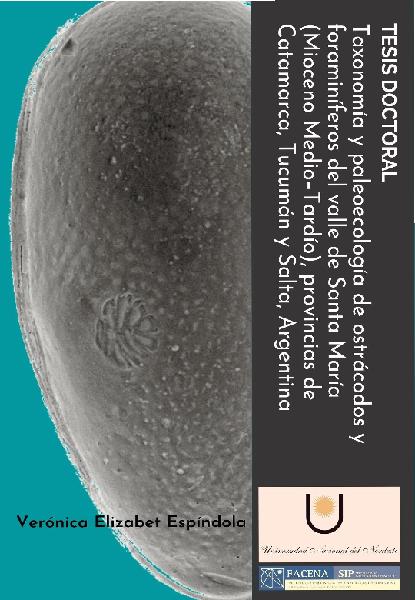
Taxonomía y paleoecología de ostrácodos y foraminíferos del valle de Santa María (Mioceno Medio-Tardío), provincias de Catamarca, Tucumán y Salta, Argentina
(Universidad Nacional del Nordeste. Facultad de Ciencias Exactas y Naturales y Agrimensura, 2019)En la presente tesis se realiza el primer análisis micropaleontológico integral de ostrácodos y foraminíferos fósiles procedentes de las Formaciones San José (Mioceno Medio) y Chiquimil (Mioceno Superior) del Grupo Santa ... -
Study of helminth parasites of amphibians by scanning electron microscopy
(IntechOpen, 2012-03-09)Amphibians, like all other animals, are subject to a variety of parasites and diseases, including viral, bacterial and fungal infections as well as some forms of cancer and tuberculosis (Hoff et al., 1984). Various viruses ... -
Pollen morphology of eight species of stemodia (plantaginaceae) from South America
(Taylor & Francis, 2011-10-25)The pollen morphology of eight species of Stemodia L. (Plantaginaceae) was analysed with the aim of refining the taxonomy of this genus. The pollen grains were examined with both light and scanning electron microscopes. ... -
Assessment of the abundance and diversity of calliphoridae and sarcophagidae (diptera) in sites with different degrees of human impact in the Iberá Wetlands (Argentina)
(Entomological Society of America, 2016-04-22)The aim of the present study was to explore the diversity and describe the spatial distribution of Calliphoridae and Sarcophagidae along an urbanization gradient in the Iber_a Wetlands. The flies were collected at 18 ... -
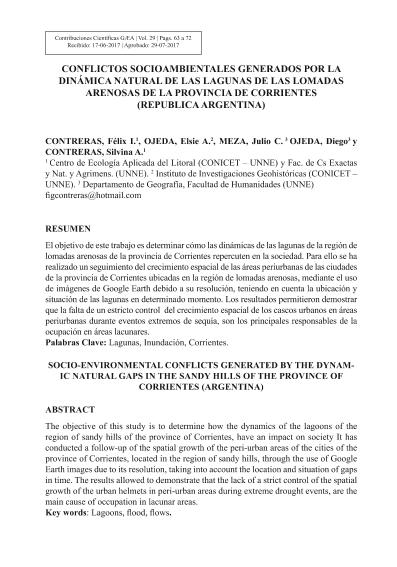
Conflictos socioambientales generados por la dinámica natural de las lagunas de las lomadas arenosas de la provincia de Corrientes (República Argentina)
(Sociedad Argentina de Estudios Geográficos, 2017-07-29)El objetivo de este trabajo es determinar cómo las dinámicas de las lagunas de la región de lomadas arenosas de la provincia de Corrientes repercuten en la sociedad. Para ello se ha realizado un seguimiento del crecimiento ... -
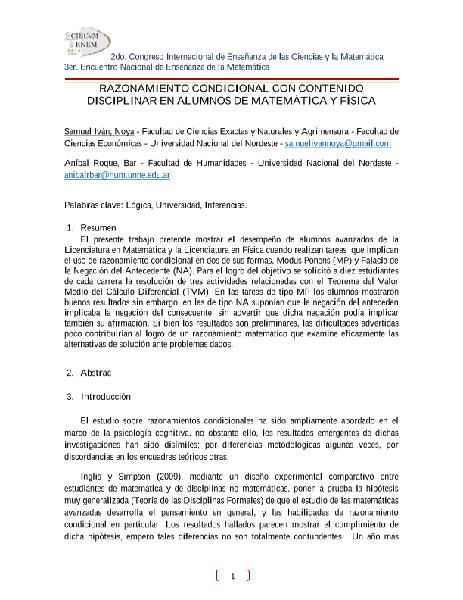
Razonamiento condicional con contenido disciplinar en alumnos de matemática y física
(Núcleo de Investigación en Enseñanza de las Ciencias y la Tecnología, 2016-09-06)El presente trabajo pretende mostrar el desempeño de alumnos avanzados de la Licenciatura en Matemática y la Licenciatura en Física cuando realizan tareas que implican el uso de razonamiento condicional en dos de sus ... -
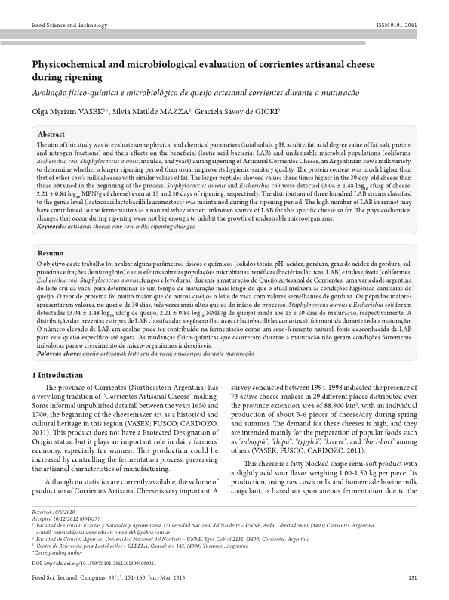
Physicochemical and microbiological evaluation of Corrientes artisanal cheese during ripening
(Sociedade Brasileira de Ciência e Tecnologia de Alimentos, 2013-03-19)The aim of this study was to evaluate some physical and chemical parameters (total solids, pH, acidity, fat, acid degree value of fat, salt, protein and nitrogen fractions) and their effects on the beneficial (lactic acid ... -
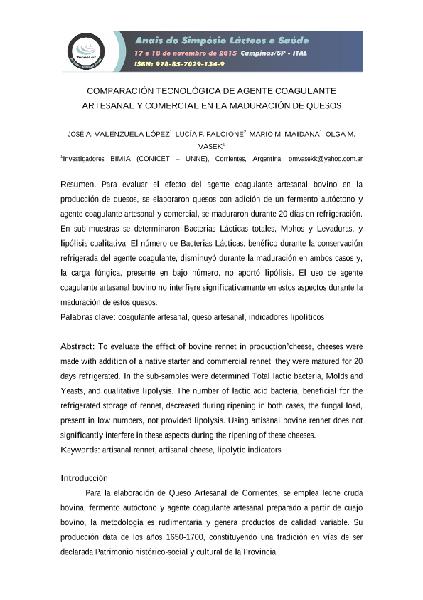
Comparación tecnológica de agente coagulante artesanal y comercial en la maduración de quesos
(Centro de Tecnología de Laticínios do Instituto de Tecnología de Alimentos, 2015-11-17)Para evaluar el efecto del agente coagulante artesanal bovino en la producción de quesos, se elaboraron quesos con adición de un fermento autóctono y agente coagulante artesanal y comercial, se maduraron durante 20 días ... -
Karyotypes of some species of the genus Lessingianthus (vernonieae, asteraceae) and taxonomic implications
(Wiley, 2014-09-11)We determined the karyotypes of nine species of Lessingianthus , eight of which are here analyzed for the fi rst time. Th e results include the fi rst chromosome count for L. plantaginoides , which is tetraploid with 2n ... -
The taxonomic utility of micromorphology in Lepidaploa (Vernonieae: Asteraceae)
(John Wiley & Sons Ltd, 2018-05-02)Lepidaploa belongs to the Vernonieae tribe, one of the most complex tribes of Asteraceae. Nowadays, the relationship between Lepidaploa and its related genera is poorly understood. Different microcharacters might be of ... -
A new polyploid species of mecardonia (gratioleae, plantaginaceae) from South America
(Magnolia Press, 2017-04-13)Mecardonia reneeae, a new species from northeastern Argentina, is described and illustrated. This taxon has certain resem- blance to M. procumbens var. flagellaris, but can be easily distinguished by the combination of ... -
Escarabajos copronecrófagos (scarabaeidae: scarabaeinae) de la reserva natural educativa Colonia Benítez, Chaco, Argentina
(Universidad Autónoma de México, 2015-02-26)Se describe la composición de escarabeinos de la Reserva Natural Educativa Colonia Benítez. Se realizaron 6 muestreos en bosque de quebracho y selva en galería en periodo seco y lluvioso. Los escarabajos se recolectaron ... -
Patrón espacial y temporal de las colectividades de artrópodos asociados a macrófitas en un río subtropical de bajo orden (Chaco, Argentina)
(Interciencia, 2012-07)El objetivo de este estudio fue conocer la composición y abundancia del ensamble de artrópodos asociados a la vegetación acuática en diferentes tramos de un río de llanura, situado en la región Neotropical, provincia ... -
Spatial and temporal variation of dung beetle assemblages in a fragmented landscape at eastern humid Chaco
(Springer, 2014-12-05)The aims of this study were to characterize the fauna of dung beetles and analyze their spatial and temporal diversity in a cattle ranch in the province of Chaco. Seven surveys were conducted in three environmental units: ... -
Changes in the structure of melolonthidae (coleoptera: scarabaeoidea) assemblages along a temporal gradient in a natural reserve in Chaco, Argentina
(Wiley Online Library, 2017-05-26)Melolonthidae beetles have been proposed as bioindicators because of their important role in the ecosystem and sensitivity to disturbance processes. However, the assemblage structure of these species in Argentina is ... -
First reports of the invasive pest bermudagrass stem maggot, atherigona reversura villeneuve, 1936 (diptera: muscidae), in south america
(Pensoft Publishers, 2016-07-15)This study presents the first occurrence of Atherigona reversura in South America. This muscid, commonly known as shoot-fly, is a significant pest of cereal crops throughout the Old World tropics and subtropics. Several ... -
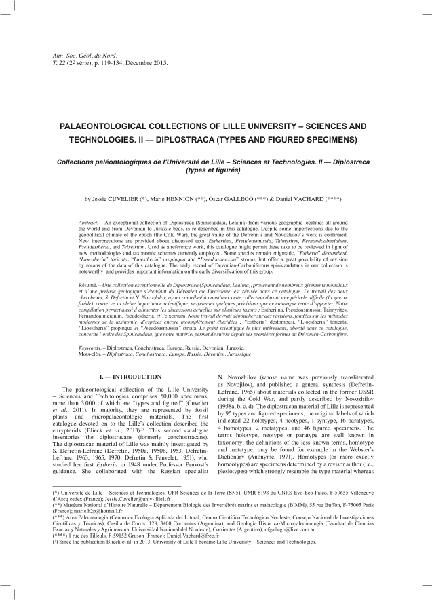
Palaentological collections of Lille University. Sciences and Technologies. II diplostraca (types and figures specimens)
(Société Géologique du Nord, 2015)An exceptional collection of Diplostraca (Spinicaudata, Leaiina) from various geographic localities all around the world and from Devonian to Jurassic beds, is re-described in this catalogue. Despite some imperfections ... -
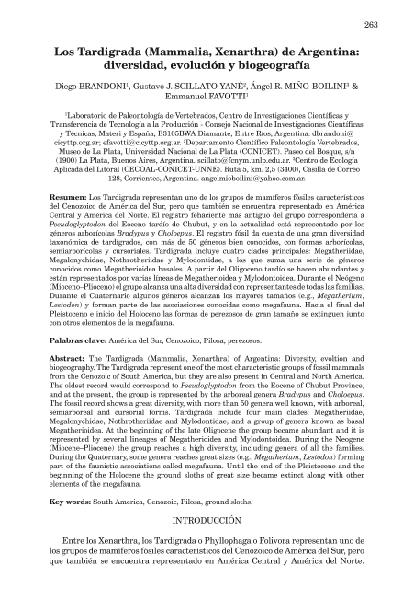
Los tardigrada (mammalia, xenarthra) de Argentina : diversidad, evolución y biogeografía
(Universidad Nacional de La Plata. Facultad de Ciencias Naturales y Museo, 2016)Los Tardigrada representan uno de los grupos de mamíferos fósiles característicos del Cenozoico de América del Sur, pero que también se encuentra representado en América Central y América del Norte. El registro fehaciente ... -
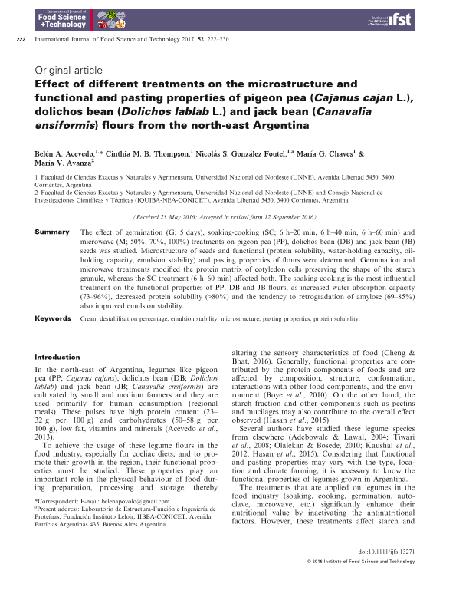
Effect of different treatments on the microstructure and functional and pasting properties of pigeon pea (cajanus cajan L.), dolichos bean (dolichos lablab L.) and jack bean (canavalia ensiformis) flours from the north-east Argentina
(Institute of Food Science and Technology, 2017)The effect of germination (G; 5 days), soaking-cooking (SC; 6 h–20 min, 6 h–40 min, 6 h–60 min) and microwave (M; 50%, 70%, 100%) treatments on pigeon pea (PP), dolichos bean (DB) and jack bean (JB) seeds was studied. ...