







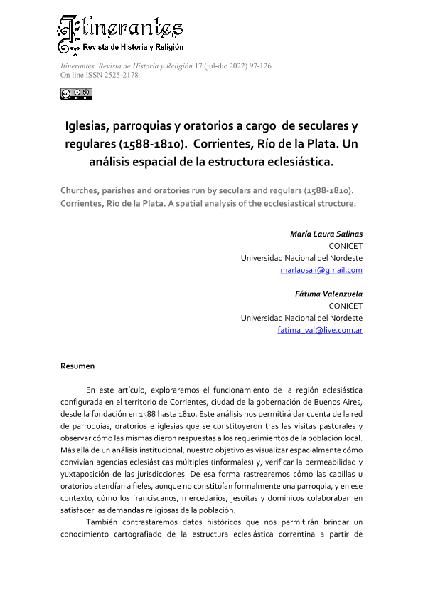
Iglesias, parroquias y oratorios a cargo de seculares y regulares (1588-1810). Corrientes, Río de la Plata. Un análisis espacial de la estructura eclesiástica
Churches, parishes and oratories run by seculars and regulars (1588-1810). Corrientes, Río de la Plata. A spatial analysis of the ecclesiastical structure
Fecha
2022Metadatos
Mostrar el registro completo del ítemResumen
En este artículo, exploraremos el funcionamiento de la región eclesiástica
configurada en el territorio de Corrientes, ciudad de la gobernación de Buenos Aires,
desde la fundación en 1588 hasta 1810. Este análisis nos permitirá dar cuenta de la red
de parroquias, oratorios e iglesias que se constituyeron tras las visitas pastorales y
observar cómo las mismas dieron respuestas a los requerimientos de la población local.
Más allá de un análisis institucional, nuestro objetivo es visualizar espacialmente cómo
convivían agencias eclesiásticas múltiples (informales) y, verificar la permeabilidad y
yuxtaposición de las jurisdicciones. De esa forma rastrearemos cómo las capillas u
oratorios atendían a fieles, aunque no constituían formalmente una parroquia, y en ese
contexto, cómo los franciscanos, mercedarios, jesuitas y dominicos colaboraban en
satisfacer las demandas religiosas de la población.
También contrastaremos datos históricos que nos permitirán brindar un
conocimiento cartografiado de la estructura eclesiástica correntina a partir de información de las visitas pastorales, documentación institucional de la ciudad como
ser las actas del cabildo y otros datos tomados de las actas parroquiales que implicarán
una confrontación empírica del funcionamiento eclesiástico estudiado. This article explores the functioning of the ecclesiastical region configured in the
territory of Corrientes, a city in the government of Buenos Aires, from its foundation in
1588 to 1810. This analysis will allow us to account for the network of parishes,
oratories, and churches that were established after the pastoral visits and observe how
they responded to the requirements of the local population. Beyond an institutional
analysis, our objective is to spatially visualize how multiple (informal) ecclesiastical
agencies coexisted and verify the jurisdictions' permeability and juxtaposition. In this
way, we will trace how the chapels or oratories served the faithful, although they did
not formally constitute a parish, and in this context, how the Franciscans,
Mercedarians, Jesuits, and Dominicans collaborated in satisfying the religious demands
of the population.
We will also contrast historical data that will allow us to provide a mapped
knowledge of the ecclesiastical structure of Corrientes based on information from
pastoral visits, institutional documentation of the city such as the acts of the town hall,
and other data taken from the parish acts that will imply an empirical confrontation of
the studied ecclesiastical functioning.
Colecciones
- Artículos de revista [1419]

Excepto si se señala otra cosa, la licencia del ítem se describe comoopenAccess