








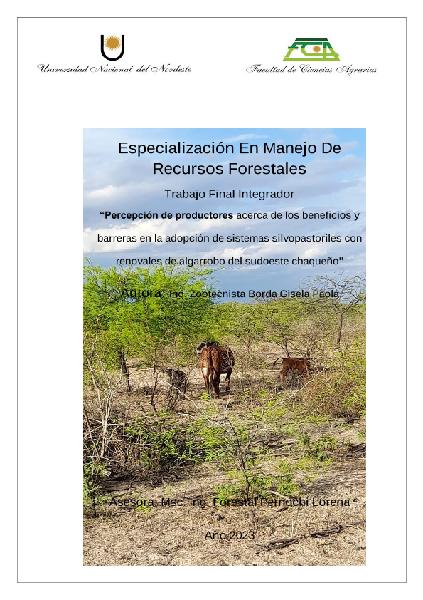
Percepción de productores acerca de los beneficios y barreras en la adopción de sistemas silvopastoriles con renovales de algarrobo del sudoeste chaqueño
Resumen
El objetivo de este trabajo fue explorar los principales beneficios y barreras percibidos por un grupo de productores al implementar sistemas silvopastoriles con renovales de Neltuma sp. en el sudoeste del Chaco. Se realizó una revisión bibliográfica de la información disponible sobre los beneficios de la utilización de estos sistemas enumerando en un cuadro los principales: productivos, económicos y ambientales. Se observó que la mayoría de los trabajos se centran en el beneficio ambiental. Se realizaron 14 entrevistas de tipo semi estructuradas con preguntas abiertas y cerradas a productores del sudoeste chaqueño. Se caracterizó a los productores encontrándose que la mayoría son pequeños productores, tienen en promedio 47 años y el 78.5% son hombres. El 56% de ellos tiene estudios universitarios, completos e incompletos. También se caracterizó el manejo que se realiza en estos renovales en la componente arbórea. Y aspectos de la componente forrajera y ganadera. Estos productores perciben beneficios económicos y ambientales. Los beneficios mencionados coinciden con los encontrados en la bibliografía. Las principales barreras que perciben en estos sistemas es el alto costo y la falta de mano de obra, como así también la dificultad para acceder a créditos. The objective of this work was to explore the main benefits and barriers perceived by a group of producers to implement silvopastoral systems with Neltuma renovales in the southwest of Chaco. A bibliographic review of the available information on the benefits of using these systems was carried out, listing in a table the main ones: productive, economic and environmental. It was observed that most of the works are focused on the environmental benefits. Fourteen semi-structured interviews with open and closed questions were conducted with farmers from the southwest of Chaco region. The farmers were characterized and it was found that most of them are small farmers, they are on average 47 years old and 78.5% are men. 56% of them have a university education. Of these, 56% have completed or incomplete university studies. The management of the tree component of these plantations was also characterized. And aspects of the forage and livestock component. These farmers perceive economic and environmental benefits. The benefits mentioned coincide with those found in the bibliography. The main barriers they perceive in these systems are the high cost and the lack of labor, as well as the difficulty to access credit.
Colecciones

Excepto si se señala otra cosa, la licencia del ítem se describe comoopenAccess