








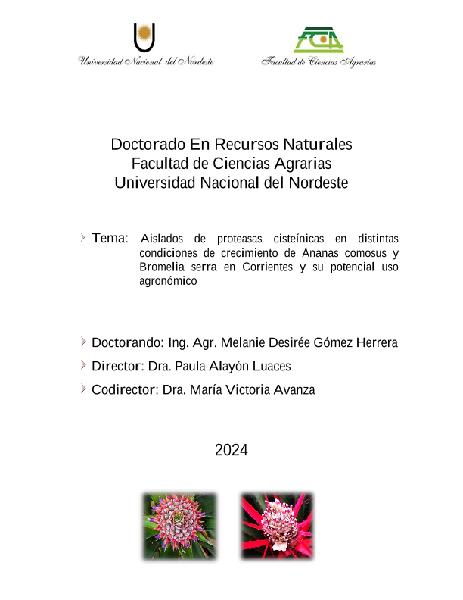
Aislados de proteasas cisteínicas en distintas condiciones de crecimiento de Ananas comosus y Bromelia serra en Corrientes y su potencial uso agronómico
Fecha
2024Metadatos
Mostrar el registro completo del ítemResumen
Algunas especies nativas de la familia de las Bromeliaceae se caracterizan por poseer
endopeptidasas en cantidades superiores a las fisiológicamente necesarias, lo que constituye
una potencialidad muy atractiva debido a los múltiples usos biotecnológicos que poseen
dichas enzimas. Se ha comprobado que la bromelina de tallo de Ananas comosus (L.) Merr.
posee múltiples usos como controlador de ciertos microorganismos fitopatógenos y
aplicaciones en la industria de los alimentos. Además, existen antecedentes que demuestran
que ante condiciones de estrés hídrico se estimula la expresión de genes que codifican para
la transcripción de cisteína proteasas en Arabidopsis thaliana, lo cual podría favorecer a un
aumento en el contenido de enzimas proteolíticas en la planta. En el caso de la especie
Bromelia serra Griseb., hasta el momento, existen escasos estudios acerca de la
caracterización de enzimas y su aplicación. Considerando la importancia creciente que han
adquirido las enzimas proteolíticas en la industria, los objetivos de esta investigación fueron:
i) analizar el perfil de proteasas cisteínicas existentes en aislados de hojas de B. serra en
distintas estaciones del año, ii) estudiar el comportamiento de proteasas cisteínicas de A.
comosus bajo distintas condiciones de estrés hídrico, iii) evaluar el uso de las proteasas
cisteínicas de Ananas comosus y Bromelia serra como producto orgánico para el control de
microorganismos fitopatógenos, y iv) evaluar el efecto de las enzimas de B. serra sobre la
coagulación de la leche bovina. Los resultados mostraron que las concentraciones de
proteínas y actividad enzimática obtenida a partir de hojas de B. serra no varió
estadísticamente en diferentes estaciones del año. La actividad proteolítica específica
(Ucas/mg de proteína) de los extractos de Bromelia serra aumentó al emplear la precipitación
con acetona y etanol en comparación al extracto crudo. Se detectaron cisteíno y asparto
proteasas en el aislado enzimático de Bromelia serra (AEB) utilizando técnicas de medición
de actividad en presencia de inhibidores. Se observó que el AEB presentó actividad en un
rango de pH de 2,7 a 7, mostrando mayor actividad en pH ácidos. Además, se evidenció una
alta estabilidad térmica en los AEB obteniendo un 47% de actividad residual luego de pre
incubar por una hora a 98°C. Asimismo, se alcanzó la máxima actividad proteolítica a una
temperatura de 60ºC. Se destaca la fácil inactivación del AEB frente al efecto de NaCl, lo que señala una sensibilidad particular de estas enzimas a las condiciones de alta salinidad.
Utilizando la cromatografía de exclusión molecular, se logró detectar en el AEB fraccciones
proteolíticas con pesos moleculares distintos de 21 y 54 kDa. Respecto al estudio del
comportamiento de proteasas cisteínicas de Ananas comosus bajo distintas condiciones de
estrés hídrico, se utilizaron como indicadores del estrés el NDVI y CRA, demostrando que
NDVI detecto el estrés hídrico (p<0,05) a los 2 meses de iniciado el ensayo entre
tratamientos. La caracterización de los extractos crudos de ananá de tallo (ECAt) y hoja
(ECAh), mostraron mayor actividad proteolítica sobre azocaseína y mayor concentración de
proteína al aumentar el estrés hídrico. Las técnicas utilizadas para caracterizar el peso
molecular de las proteínas y su actividad gelatinolítica permitieron detectar diferencias de
acuerdo al tipo de órgano y el nivel de estrés hídrico. En general, en el caso del ECAt se
detectaron varias proteínas a medida que aumentó el nivel de estrés hídrico, pero la banda
más marcada y con mayor actividad gelatinolítica fue la de 25 kDa. En el caso de del ECAh,
también se observaron varias proteínas, predominando la de peso molecular de 22 kDa con
mayor actividad gelatinolítica al aumentar el estrés hídrico. Al comparar los perfiles
cromatográficos de la bromelina comercial con los perfiles de aislado enzimático tallo
(AEAt) y hoja (AEAh) se encontró un pico con el mismo tiempo de retención (23 min). En
la bromelina comercial esa fracción contuvo proteínas de 16, 22 y 25 kDa (23 min). En el
caso del pico de AEAh se correspondió con una banda de 22 kDa y con el AEAt dos bandas
proteicas de 12 y 25 kDa (23 min). Los picos de retención (23 min) de ambos aislados
presentaron mayor actividad proteolítica el tratamiento estresado (25%CC) que en el no
estresado (100%CC). La actividad con LNPE (α-N-CBZ-L-lisin-p-nitrofenil éster) fue mayor
con los tratamientos estresados, tanto en hoja como en tallo, por lo que se podría inferir que
a mayor estrés hídrico hay mayor actividad de la bromelina del tallo. Respecto al uso de las
proteasas cisteínicas de A. comosus y B. serra como producto orgánico para el control de
microorganismos fitopatógenos en bacterias y en hongo (Xanthomonas axonopodis pv.
manihotis, X. citri pv. Citri, Clavibacter michiganensis subsp. michiganensis, Ralstonia
solanacearum, Pseudomonas syringae pv. Tomate y Fusarium oxysporum), no se detectó
inhibición con ninguno de los microorganismos estudiados. Por último, al estudiar efecto de
las enzimas de serra sobre la coagulación de la leche bovina, se prepararon en un ensayo
previo hidrolizados de caseína utilizando AEB a diferentes tiempos. El hidrolizado obtenido tras un tratamiento de 240 minutos exhibió la actividad antioxidante (ABTS) más elevada en
comparación con los demás tratamientos obteniendo un hidrolizado con un grado de
hidrólisis de 12% con un valor de TEAC de 1,10µM/mg e IC50 de 1,68 (mg/mL). Una vez
estudiado el efecto del AEB sobre la caseína, se procedió a los estudios de coagulación de la
leche, que si bien presentaron valores bajos pueden aumentarse concentrando el AEB. Estos
ensayos permiten sentar base para estudios futuros para la manufactura de quesos,
reemplazando el cuajo de origen animal, por vegetal. Posteriormente deberán realizarse
estudios correspondientes a pruebas de acidez, alcohol, enzima reductasa o también
denominada reducción del azul de metileno la leche y análisis sensorial a la manufactura de
quesos. Estos estudios realizados durante la tesis sientas las bases de que el aumento del
estrés hídrico en ananá aumenta la actividad de la bromelina de tallo y por otro lado al utilizar
AEB como una herramienta capaz de hidrolizar otros sustratos proteicos que puedan derivar
en péptidos con bioactividad como es la actividad antioxidante, entre otros usos en la
industria agroalimentaria. Some native species of the Bromeliaceae family are characterized by having endopeptidases
in higher quantities than those that are physiologically necessary, which constitutes a very
attractive potential due to the multiple biotechnological uses of these enzymes. It has been
proven that the stem bromelain of Ananas comosus (L.) Merr. has multiple uses as a
controller of certain phytopathogenic microorganisms and applications in the food industry.
Furthermore, there is evidence that under water stress conditions, the expression of genes
that encode the transcription of cysteine proteases in Arabidopsis thaliana is stimulated,
which could favor an increase in the content of proteolytic enzymes in the plant. In the case
of the species Bromelia serra Griseb., there are few studies on the characterization of
enzymes and their application. Considering the growing importance that enzymes have
acquired in the industry, the objectives of this research were: i) analyze the profile of cysteine
proteases in isolates from organs of B. serra in different seasons of the year, ii) study the
behavior of cysteine proteases of Ananas comosus under different water stress conditions,
iii) evaluate the use of cysteine proteases from A. comosus and B. serra as an organic product
for the control of phytopathogenic microorganisms, and iv) evaluate the effect of B. serra
enzymes on coagulation of bovine milk. Regarding the study of B. serra in different
seasons of the year, the concentrations of proteins and enzymatic activity obtained from
leaves did not vary according to the year's seasons. An important finding was the
considerable increase in the proteolytic activity of B. serra extracts when precipitation with
acetone and ethanol was used. Cysteine and aspartic proteases were detected using inhibitor
measurement techniques. AEB presented activity in a pH range of 2.7 to 7, showing higher
activity at acidic pH. Furthermore, high thermal stability was evident in the AEB, obtaining
47% residual activity after pre-incubation for one hour at 98°C. In addition, it reached its
maximum proteolytic activity at 60ºC. The easy deactivation of B. serra enzyme isolate
(AEB) against the effect of NaCl stands out, which indicates a particular sensitivity of these
enzymes to high salinity conditions. Using size exclusion chromatography, it was possible to
isolate two proteolytic enzymes with different molecular weights of 21 and 54 kDa. Regarding the study of the behavior of cysteine proteases of A. comosus under different
conditions of water stress, NDVI and CRA (RWC) were used as indicators of water stress,
demonstrating that NDVI detected water stress among treatments (p<0.05) 2 months after
the experiment started. The pineapple stem (ECAt) and leaf (ECAh) extracts showed higher
proteolytic activity and protein concentration as water stress increased. The techniques used
to characterize the molecular weight of the proteins and their gelatinolytic activity were
different in terms of the type of organ and level of water stress. In general, in the case of the
stem extract, several proteins were found as the stress level increased, but the most marked
band and with the highest gelatinolytic activity was that of 25 kDa. In the case of the leaf
extract, several proteins were also observed, predominating the one with a molecular weight
of 22 kDa with higher gelatinolytic activity when water stress increased. When comparing
the profiles of commercial bromelain with the stem and leaf profiles, a peak was found that
was retained at the same time during chromatography (23 min). In commercial bromelain,
these peaks corresponded to proteins of 16, 22, and 25 kDa (23 min). In the case of the peak
of the leaf isolate (AEAh), it corresponded to a band of 22 kDa, and with the stem isolate
(AEAt), two protein bands of 12 and 25 kDa (23 min). The retention peaks of both isolates
presented higher proteolytic activity in the stressed treatment (25% CC) than in the nonstressed treatment (100% CC). The activity with LNPE (α-N-CBZ-L-lysine-p-nitrophenyl
ester) was higher with the stressed treatments, both in the leaf and the stem, so it could be
inferred that the greater the water stress, the greater the activity of bromelain in the stem.
Regarding the use of cysteine proteases from Ananas comosus and B. serra as an organic
product to control phytopathogenic microorganisms in bacteria and fungi
(Xanthomonas axonopodis pv. manihotis, X. citri pv. Citri,
Clavibacter michiganensis subsp. michiganensis, Ralstonia solanacearum,
Pseudomonas syringae pv. Tomato and Fusarium oxysporum), no inhibition was detected
with any of the microorganisms studied. Finally, when studying the effect of Bromelia serra
enzymes on the coagulation of bovine milk, casein hydrolysates were prepared using AEB at
different times, as a prior study to the coagulation of milk and the influence that temperature
has on the strength of rennet. The hydrolyzate obtained after a 240-minute treatment
exhibited the highest antioxidant activity (ABTS) compared to the other treatments,
obtaining a hydrolyzate of 12% with a TEAC value of 1.10µM/mg and IC50 of 1.68 (mg/mL). Once the effect of AEB on casein had been studied, milk coagulation studies were done,
which, although they presented low values, could be increased by concentrating the AEB.
These tests lay the foundation for future studies for the manufacture of cheeses, replacing
rennet of animal origin with vegetable ones. Subsequently, studies corresponding to acidity,
alcohol, reductase tests on milk, and sensory analysis on cheese manufacturing must be
carried out. These studies carried out during the thesis lay the foundations for the verification
that the increase in water stress in pineapple increases the activity of stem bromelain and, on
the other hand, enzyme isolates from B. serra can be used as a tool capable of hydrolyzing
other protein substrates that can lead to peptides with bioactivity such as antioxidant activity,
among other uses in the agri-food industry.
Colecciones
- Tesis doctoral [31]

Excepto si se señala otra cosa, la licencia del ítem se describe comoopenAccess