







Hongos geofílicos en la zona occidental de la región chaqueña (Argentina)
Geophilic fungi in western zone of Chaco región, Argentina
Fecha
2007Metadatos
Mostrar el registro completo del ítemResumen
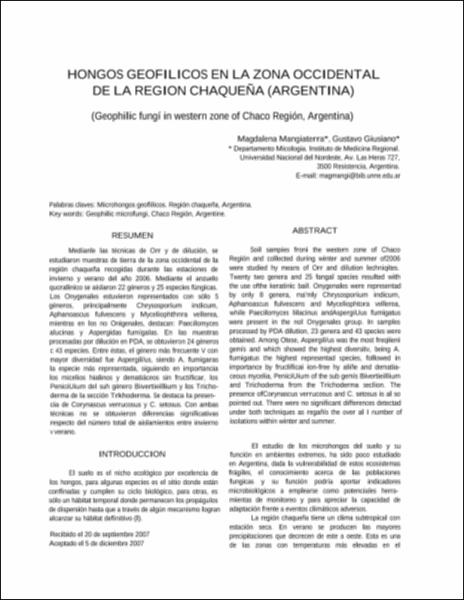
Medíanle las técnicas de Orr y de dilución, se estudiaron muestras de tierra de la zona occidental de la región chaqueña recogidas durante las estaciones de invierno y verano del año 2006. Mediante el anzuelo qucralinico se aislaron 22 géneros y 25 especies fúngicas. Los Onygenales estuvieron representados con sólo S géneros, principalmente Chrysosporium indicum, Aphanoascus fulvescens y Myceliophthnra vellerea, mientras en los no Onigenales, destacan: Paecilomyces alucinas y Aspergidas fumígalas. En las muestras procesadas por dilución en PDA, se obtuvieron 24 géneros
c 43 especies. Entre éstas, el género más frecuente V con mayor diversidad fue Aspergil/us, siendo A. fumigaras la especie más representada, siguiendo en importancia los micelios hialinos y dematiáceos sin fructificar, los
PeniciUium del suh género Bivertieillium y los Trichoderma de la sección Trkhoderma. Se destaca Ia presencia de Corynascus verrucosus y C. setosus. Con ambas
técnicas no se obtuvieron diferencias significativas respecto del número total de aislamientos entre invierno y verano. Soil sampies froni the western zone of Chaco Región and collected during winter and summer of2006 were studied hy means of Orr and dilution lechniqites. Twenty two genera and 25 fangal species resulted with the use ofthe keratinic bail. Onygenales were representad by only 8 genera, ma'mly Chrysosporium indicum, Aphanoascus fulvescens and Myceliophtora vellerea, while Paecilomyces lilacinus andAspergiUus fumigatus were present in the nol Onygenales group. In samples processed by PDA dilution, 23 genera and 43 species were obtained. Among Otese, Aspergil/us was the most freqiieni gemís and which showed the highest diversitv, being A. fumigatus the highest representad species, followed in importance by fruclificai ion-free hy aliñe and dematiaceous mycelia, PeniciUium of the sub gemís Bivertieillium
and Trichoderma from the Trichoderma seclion. The presence ofCorynascus verrucosus and C. setosus is al so pointed out. There were no significant differences detectad under both techniques as regañís the over al I number of isolations within winter and summer.
Colecciones
- Artículos de revista [63]

Excepto si se señala otra cosa, la licencia del ítem se describe comoopenAccess