







Mostrar el registro sencillo del ítem
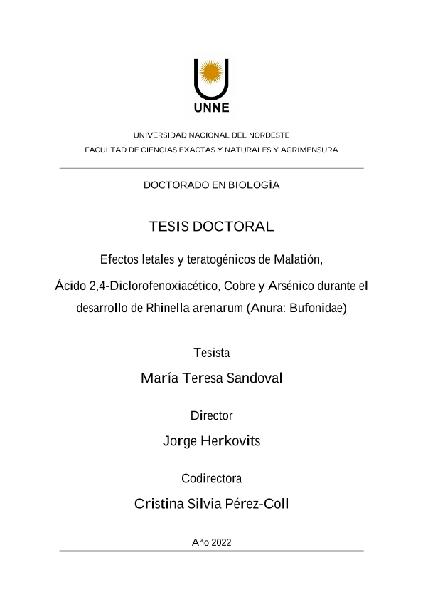
Efectos letales y teratogénicos de Malatión, Ácido 2,4-Diclorofenoxiacético, Cobre y Arsénico durante el desarrollo de Rhinella arenarum (Anura: Bufonidae)
| dc.contributor.advisor | Herkovits, Jorge | |
| dc.contributor.advisor | Pérez Coll, Cristina Silvia | |
| dc.contributor.author | Sandoval, María Teresa | |
| dc.date.accessioned | 2024-02-14T14:53:51Z | |
| dc.date.available | 2024-02-14T14:53:51Z | |
| dc.date.issued | 2022 | |
| dc.identifier.citation | Sandoval, María Teresa, 2022. Efectos letales y teratogénicos de Malatión, Ácido 2,4-Diclorofenoxiacético, Cobre y Arsénico durante el desarrollo de Rhinella arenarum (Anura: Bufonidae). Tesis doctoral. Corrientes: Universidad Nacional del Nordeste. Facultad de Ciencias Exactas y Naturales y Agrimensura. | es |
| dc.identifier.uri | http://repositorio.unne.edu.ar/handle/123456789/53020 | |
| dc.description.abstract | Historically, man has modified his natural environment for his benefit. Human activities and the intensive use of natural resources have led to gradual environmental deterioration. Environmental pollution constitutes a highly complex problem due to the multiplicity of factors involved in the dynamics of polluting compounds and is considered one of the causes of the decline of amphibian populations. Amphibians, due to their thin, permeable skin, shellless eggs, and biphasic life cycle, are especially vulnerable to environmental contaminants. Among these environmental contaminants, agricultural pesticides are of special interest due to their presence in agroecosystems, where many species of anurans inhabit. Likewise, heavy metals constitute a highly dangerous group because of their toxicity, also and their quantity in the environment may be increased by different human activities. To provide basic toxicological information useful to predict the impact of pollutants on non-target organisms, the following objectives were proposed: 1) to analyze the toxicity of the insecticide malathion, the herbicide 2,4-D, copper and arsenic, using standardized toxicity bioassays with embryos and larvae of Rhinella arenarum (Anura: Bufonidae) at different stages of development, 2) to evaluate the lethal and sublethal effects on embryos and larvae caused by these compounds, 3) to evaluate the stage-dependent susceptibility for each selected chemical and to identify the most sensitive stages of development, 4) to compare the toxicity of the inner ingredient of organic pesticides, malathion, and 2,4-D, with its commercial formulations, Glacoxan 50M® and Esterón Ultra®, respectively. For this, standardized protocols of the AMPHITOX test were used: AMPHIEMB, AMPHIACUT, AMPHISHORT, AMPHICHRO, and PULSE EXPOSURE tests. The evaluated endpoints were: lethality, narcosis, behavioral and morphological alterations, and delay in developmental and growth alterations. Based on mortality and malformations data, the LCs 10, 50, and 90 and the TI for each toxicant analyzed were calculated. The insecticide malathion (inner ingredient) has a narcotic and lethal effect, a teratogenic potential, and the ability to alter the behavior and the growth of embryos and larvae of Rhinella arenarum. The commercial Glacoxan 50M® was several times more lethal than the i.a. The susceptibility of Rhinella arenarum shows a stage-dependent relationship, the E. 25 was the most susceptible to the lethal effect. The herbicide 2,4-D (inner ingredient) and its commercial formulation, Esterón Ultra®, have a significant lethal effect on Rhinella arenarum larvae, being the commercial formulation more toxic than the inner ingredient. Esterón Ultra® has also teratogenic capacity and alters the morphogenesis and growth of the embryos. The early embryonic stages were the most susceptible to the herbicide's toxic effect. The greater toxicity of the commercial formulations compared to the inner ingredient may be due to the presence of adjuvants in their composition. Copper chloride and sodium arsenite have a significant lethal effect and teratogenic capacity on embryos and larvae of Rhinella arenarum. Finally, the teratogenic mechanism of the studied compounds does not exert its action on a specific organ but rather alters the morphogenetic processes. Consequently, any structure or organ developing at the time or after exposure to these compounds may develop a morphological abnormality. This highlights the high susceptibility of early embryonic and larval stages and the need to include them in ecotoxicological evaluations. | es |
| dc.format | application/pdf | es |
| dc.format.extent | 214 p. | es |
| dc.language.iso | spa | es |
| dc.publisher | Universidad Nacional del Nordeste. Facultad de Ciencias Exactas y Naturales y Agrimensura | es |
| dc.rights | openAccess | es |
| dc.rights.uri | http://creativecommons.org/licenses/by-nc-nd/2.5/ar/ | es |
| dc.subject | Rhinella arenarum | es |
| dc.subject | Malatión | es |
| dc.subject | Ácido 2,4 - Diclorofenoxiacético | es |
| dc.subject | Plaguicidas | |
| dc.subject | Insecticidas | |
| dc.subject | Herbicidas | |
| dc.subject | Metales pesados | |
| dc.title | Efectos letales y teratogénicos de Malatión, Ácido 2,4-Diclorofenoxiacético, Cobre y Arsénico durante el desarrollo de Rhinella arenarum (Anura: Bufonidae) | es |
| dc.type | Tesis doctoral | es |
| unne.affiliation | Fil: Sandoval, María Teresa. Universidad Nacional del Nordeste. Facultad de Ciencias Exactas y Naturales y Agrimensura; Argentina. | es |
| unne.affiliation | Fil: Herkovits, Jorge. Fundación Pro Salud y Medio Ambiente; Argentina. | es |
| unne.affiliation | Fil: Pérez Coll, Cristina Silvia. Universidad Nacional de San Martín; Argentina. | es |
| unne.description.grado | Doctor en Biología | es |
Ficheros en el ítem
Este ítem aparece en la(s) siguiente(s) colección(ones)
-
Tesis doctoral [135]

Excepto si se señala otra cosa, la licencia del ítem se describe comoopenAccess