





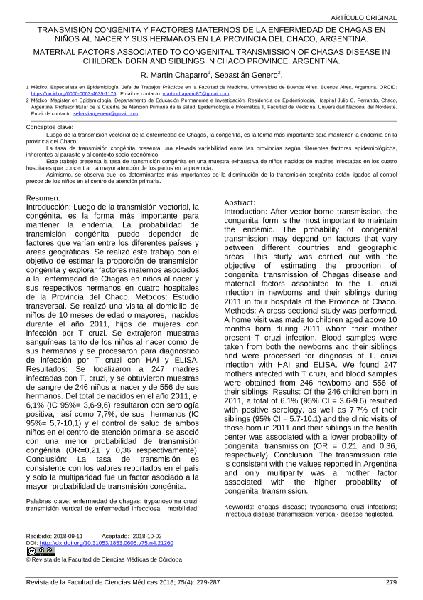
Transmisión congénita y factores maternos de la enfermedad de Chagas en niños al nacer y sus hermanos en la provincia del Chaco, Argentina
Maternal factors associated to congenital transmission of Chagas disease in children born and siblings in Chaco province, Argentina
Fecha
2018Metadatos
Mostrar el registro completo del ítemResumen
Introducción: Luego de la transmisión vectorial, la
congénita, es la forma más importante para
mantener la endemia. La probabilidad de
transmisión congénita puede depender de
factores que varían entre los diferentes países y
áreas geográficas. Se realizó este trabajo con el
objetivo de estimar la proporción de transmisión
congénita y explorar factores maternos asociados
a la enfermedad de Chagas en niños al nacer y
sus respectivos hermanos en cuatro hospitales
de la Provincia del Chaco. Métodos: Estudio
transversal. Se realizó una visita al domicilio de
niños de 10 meses de edad o mayores, nacidos
durante el año 2011, hijos de mujeres con
infección por T cruzi. Se extrajeron muestras
sanguíneas tanto de los niños al nacer como de
sus hermanos y se procesaron para diagnóstico
de infección por T cruzi con HAI y ELISA.
Resultados: Se localizaron a 247 madres
infectadas con T. cruzi, y se obtuvieron muestras
de sangre de 246 niños al nacer y de 556 de sus
hermanos. Del total de nacidos en el año 2011, el
6,1% (IC 95%= 3,6-9,6) resultaron con serología
positiva, así como 7,7%; de sus hermanos (IC
95%= 5,7-10,1) y el control de salud de ambos
niños en el centro de atención primaria se asoció
con una menor probabilidad de transmisión
congénita (OR=0,21 y 0,36 respectivamente).
Conclusión: La tasa de transmisión es
consistente con los valores reportados en el país
y solo la multiparidad fue un factor asociado a la
mayor probabilidad de transmisión congénita. Introduction: After vector-borne transmission, the
congenital form is the most important to maintain
the endemic. The probability of congenital
transmission may depend on factors that vary
between different countries and geographic
areas. This study was carried out with the
objective of estimating the proportion of
congenital transmission of Chagas disease and
maternal factors associated to the T. cruzi
infection in newborns and their siblings during
2011 in four hospitals of the Province of Chaco.
Methods: A cross sectional study was performed.
A home visit was made to children aged above 10
months born during 2011 whom their mother
present T cruzi infection. Blood samples were
taken from both the newborns and their siblings
and were processed for diagnosis of T. cruzi
infection with HAI and ELISA. We found 247
mothers infected with T cruzi, and blood samples
were obtained from 246 newborns and 556 of
their siblings. Results: Of the 246 children born in
2011, a total of 6.1% (95% CI = 3.6-9.6) resulted
with positive serology, as well as 7.7% of their
siblings (95% CI = 5.7-10.1) and the clinic visits of
those born in 2011 and their siblings in the health
center was associated with a lower probability of
congenital transmission (OR = 0.21 and 0.36,
respectively). Conclusion: The transmission rate
is consistent with the values reported in Argentina
and only multiparity was a mother factor
associated with the higher probability of
congenital transmission.
Colecciones
- Artículos de revista [297]

Excepto si se señala otra cosa, la licencia del ítem se describe comoopenAccess